
One of the most perilous assumptions in modern life is that we no longer believe in myths. The more certain we are that we are rational agents in a secular society, sophisticates long divorced from the superstitions and legends of our supposedly primitive ancestors, the more susceptible we are to their pull. The anthropologist Claude Lévi-Strauss was careful to define his mission not to show “how men think in myths but how myths operate in men’s minds without their being aware of the fact.”
It may be that the Ancient World gave name and form to myth in order to recognise impulses and delusions that were already unconsciously acting upon us. Having abandoned the demigods of old, we are now perhaps more vulnerable than ever to the forces (tribalism, egocentric ambition, wishful thinking etc.) they once represented and the consequences that follow. Those who do not meet hubris and nemesis in stories are destined to first meet them in person.
Myths are hard to find in contemporary culture. Art is opaque with irony. Dominated by social media theatre and endlessly-cascading controversies, political discourse shrouds the factors that are really at play – economics, group psychology, evolutionary competition and so on. Religion and literature once offered cautionary tales, as well as embodying them, but we are largely now in a post-faith, post-literary society. Hollywood, corporations and big tech encourage us to follow dreams that they have already commodified and cannibalised. Yet myths are still present everywhere because they are how we wish to see ourselves and frame others. And while they serve functions, offering meaning and comfort in what can seem like a nihilistic existence, they can distort our perceptions, exacerbate dysfunction and lead to a deficit with reality, which makes them all the more attractive.
One of the places where mythology is still observable is in music. Given its decadence and debauchery, rock music might seem an unlikely venue for the tropes and archetypes of say chivalric mythology but that’s precisely where it survives. The band of brothers (or sisters) fellowship that was once demonstrated in the Knights of the Round Table or The Three Musketeers is still celebrated in bands. As much as we might dismiss it as PR, how many times have we seen an artist, or wave of artists, being heralded as a return to the ‘true spirit’ of rock or jazz, hip hop or folk, like Fisher Kings come to replenish a barren kingdom.
Music retains, for some, a quasi-mythic religious quality, evident in relics (pieces of Hendrix’s smashed guitars, Nina Simone’s chewing gum etc.) and places of pilgrimage (Graceland, The Cavern, Jim Morrison’s grave and so on). People who would baulk at the idea of Catholic saints have their own personal cast of heroes and martyrs, all of them touched by some Pentecostal power of inspiration. Even the jaded among us might feel the pull of the sacred and mythic when listening to something like Kind Of Blue or Unknown Pleasures or any album that feels like it fell to earth rather than simply made in a studio. We never escaped myths because they are how we want the world to be; that’s what makes them so desirable and dangerous.
An exemplar of musical evangelism is Bobby Gillespie; he sermonises, across many interviews, on the revolutionary potential of music with all the passion of a true believer. Yet myths were almost the undoing of his band Primal Scream. Having somehow, in what is still a staggering achievement, captured the future of music in the visionary Screamadelica (built kaleidoscopically from shards of the musical past and present – psychedelia, dub, dance, gospel, chill out etc.), the band stood on the edge of astonishing possibilities. Where would Primal Scream go after ‘Higher Than the Sun’?
The answer, sadly, was a kind of retreat. It’s said in the early seventies Stephen Stills (Buffalo Springfield/CSNY) got so deep into cocaine that he became convinced he’d fought in Vietnam. At some point, it appeared Primal Scream went so deep they became convinced they were the Rolling Stones. There are several reasons for this occurring, aside from drugs. Chief among them was cynicism from critics who pinned Screamadelica’s success on their collaborators, including Andrew Weatherall and The Orb; a judgement that the excellent Demodelica goes someway to dispelling. A large part of this bias stemmed from the rockist myth of authenticity which venerated stripped-down ‘purity’ (punk, power trios, rock & roll minimalism, blues etc.) and denigrated collectives like Parliament-Funkadelic. In the face of these doubts though, Primal Scream reverted to a traditional unit, even though their best work prior to Screamadelica (‘Velocity Girl’, ‘Imperial’, ‘I’m Losing More Than I’ll Ever Have’) came when they’d escaped the model of the MC5 or The Byrds.
The resulting album Give Out But Don’t Give Up is not the travesty its painted as nor is it a lost classic – its belated twin The Memphis Recordings has been held up by Gillespie as their finest moment but while more coherent and less of a facsimile, it doesn’t entirely rehabilitate a move that was largely a misstep. There’s a funkiness to the album that Britpop at the time was bereft of but it is mostly aimless and, though the lizard-hips party songs and wistful ‘No Expectations’-esque ballads are not without their charms, its momentum seems artificially induced and close to implosion. Hedonism had become decadence. Perhaps its gravest mistake, though forgivable, was one many British bands had made; they fell in love with Americana but left their audience behind on the Trans-Atlantic journey. Enthralled to see what a group of stratospheric Glaswegians would transmit from orbit, we had to settle for a postcard from Tennessee.
Yet just as myths led Primal Scream astray so it seems myths saved them. Lost in the wilderness, they were reborn with the inventive, incendiary XTRMNTR. It was a Bonfire Of The Vanities and the return of the Lost Pretender, Year Zero and the waking of the King under the Mountain or any other number of mythological tales. Yet the redemptive story arc is a false one, which vanishes Vanishing Point, an inconvenient transitional album that has a convincing claim to being their finest.
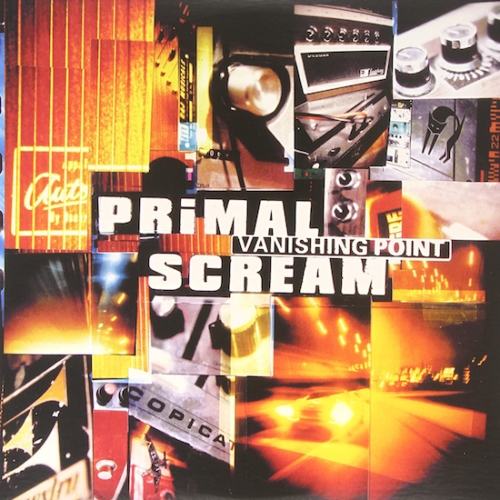
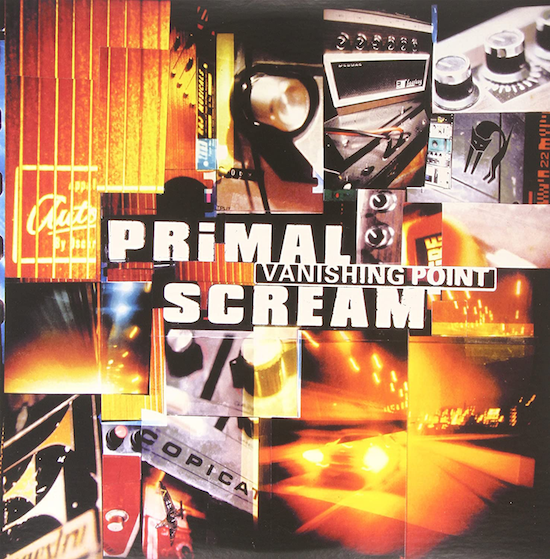
Vanishing Point was released at a cultural turning point. It came out in 1997, the same year as the Britpop Hindenburg Be Here Now, a time of excess, lamentation and the collapse of a patriotic collective hysteria, akin to the Tanganyika laughter epidemic or medieval St Vitus’ Dance outbreaks. For those partisans who had survived underground during Cool Britannia, it was a moment of liberation from a cruel and derivative yoke. Perhaps the drugs had simply changed but there was a feeling of turning a corner into darker, more interesting territory – edgier, sexier, innovative, cerebral, political with a small p, and far more atmospheric. It was the year of Chiastic Slide, Modus Operandi, Substrata, Young Team, Hard Normal Daddy. It was the year the underground seeped momentarily overground. A year of somehows. Roni Size won the Mercury Prize. ‘Come To Daddy’ was on the television. Blue Jam was on the radio. Acts in the national headlights – Portishead, Bjork, Spiritualised, Radiohead – all released far more fractured, challenging and rewarding albums than previously. And Primal Scream finally released the worthy successor to Screamadelica, mirroring the heights of its predecessor by descending into the depths.
It began in a Tokyo hotel room and a chance viewing of the 1970s film Vanishing Point, in which Kowalski, a veteran, ex-cop and race-car driver, wired on Benzedrine, is chased across the deserts of the South-West US. Gillespie and bandmate Andrew Innes were blown away, except for the soundtrack, “The music in the film is hippy music, so we thought ‘Why not record some music that really reflects the mood of the film?’” They aimed to capture “the air of paranoia and speed-freak righteousness […] rammed with claustrophobia.” So began their “anarcho-syndicalist speedfreak road-movie record”. For all its association with the movie, the album departs from Primal Scream’s earlier Americana infatuation. If it is a road movie, it is more akin to the collage of Radio On, though in technicolour contrast to Petit’s black and white. The most cinematic songs don’t feel like they necessarily belong on the freeways of Colorado. The lush ‘Get Duffy’ was inspired by Roy Budd’s Get Carter score – impossibly cool with noir grit and secret intentions – which charts a journey of revenge from London to Newcastle rather than a joyride from Denver to San Francisco. Reunited with Andrew Weatherall, ‘Trainspotting’ is a meandering dub, with stoned surf guitar and passing sirens, like driving in an altered state through a nocturnal city rather than distant deserts.
As much as any exceptional hip hop or electronic album, Vanishing Point demonstrates the power of crate-digging, when used as a prompt rather than a crutch. Its samples and influences are remade rather than remodelled (Brendan Lynch’s underrated raygun production helps). The obscenely funky bassline in ‘If They Move, Kill ‘Em’ is borrowed, and bolstered, from Bill Withers’ classic ‘Who Is He (And What Is He To You)?’ The juddering industrial ‘Kowalski’ is formed around the clattering eternally-new Jaki Liebezeit groove from Can’s ‘Halleluhwah’ (with added distortion from Funkadelic’s ‘Get Off Your Ass and Jam’) but it sounds transformed into the one genuine speed-freak song on the album; the follow-up XTRMNTR is full of them. The dance elements on Vanishing Point still sound fresh, through their obliqueness and avoiding the formulas that have caused big beat, for instance, to age like milk. Vanishing Point is built from older deeper stuff. The album is saturated in dub, the oceanic dub of say Prince Jammy’s ‘Jammy’s A Shine’, in terms of pan-continental exoticism, space and soundscaping but also because no matter how out there it gets (and ‘Stuka’ with its hallucinatory cacophony of doorbells, divebombing Jericho trumpets, and Flannery O’Connor-inspired Christ-haunted lyrics is as out there as it gets), it never loses its way. The accompanying dub remix of the album by Adrian Sherwood, Echo Dek, is less a departure than a coda.
Listening a quarter of a century after its release, there’s an intriguing paradoxical quality to Vanishing Point I hadn’t picked up on. Given the vocals are, when not absent entirely, mixed like any other instrument in the maelstrom, it was not initially obvious how at odds the lyrics are with the music. One of their gentlest moments, ‘Star’ is also the most overtly political on the album. Aided by Augustus Pablo on melodica and the Indian ‘Godfather of Percussion’ Pandit Dinesh on tabla, it’s a sweet sunlit lullaby of a song that boasted the line, “One man’s freedom fighter is another’s terrorist" and bore a photo of Bobby Hutton on the single sleeve, taken a year before the teenage Black Panther was shot over twelve times by Oakland police while surrendering after a shootout. It’s a naïve song and was treated disparagingly by reviewers but there’s something startling in its naivety, like a Henri Rousseau painting or a Robert Wyatt song.
While the Trojan horse/sweetened pill approach to politics can be effective, there are signs elsewhere of forces pulling in different directions. The laidback pseudo-raga of ‘Out of the Void’ is also strung-out with brutally introspective lyrics, “I’m a scarecrow man / I’m made of rags and straw, I’m paranoid” with its chorus yearning for childhood simplicity and comfort. The ecstatic grace with which ‘Burning Wheel’ is sung belies the merciless self-examination of the lyrics, more akin to industrial or metal, “Through my bleeding eyes / I’m filthy, fly, I crawl with insects / I’m anesthetized / I’m demonized, caught in the vortex.” Gillespie seems even more of a lost soul on the Velvets-esque b-sides ‘Jesus’, a genuine-affecting morphine hymn, and the hypnagogic but lacerating ‘How Does It Feel To Belong’.
Vanishing Point clearly stands as a Songs Of Experience to Screamdelica’s Songs Of Innocence. What happens, the album suggests, when the come-down keeps descending. The rebellious abandon of The Wild Angels sample that begins ‘Loaded’ and the uplifting communitarianism of Jesse Jackson’s Wattstax speech on ‘Come Together’ have long dispersed and in their place is the Greek chorus monologue, defiant but ill-fated, from Super Soul, Vanishing Point’s blind DJ, “Two nasty Nazi cars are close behind the beautiful lone driver… the police numbers are getting closer, closer, closer to our soul hero, in his soul mobile.”
It’s because of its darkness and its ability to burst through that Vanishing Point remains a stunning listen. This is most evident in its opening and closing tracks. ‘Burning Wheel’ begins nebulous before swirling into life as one of the finest examples of neo-psychedelia – hypnotic, euphoric, spacey as say ‘Astronomy Domine’ or ‘I Think I’m In Love’ yet with heavyweight rhythm, exploding any of the twee forgeries that are often labelled psychedelic. Here, finally, was the answer to ‘Where do you go after ‘Higher Than the Sun’?’ By contrast, the last track ‘Long Life’ is simple, near-lethargic, transcendent dream pop that simultaneously collapses in slow motion and rises like an out of body experience. Between them are journeys no film could capture.
Inevitably, given its eclecticism, Vanishing Point is not perfect. The aim was difference not consistency, and the album only dips when they chose familiarity over daring. ‘Medication’ is a garage band retread of ‘Rocks’ while ‘Motorhead’ is a punishing though spirited cover. Both are fun and superfluous. The pain and rage exhibited in the album’s lyrics would turn outwards and find voice in the fiercely political XTRMNTR but equally there are signs of Gillespie’s occasional radical naivety and gung-ho ‘why look when you can leap?’ attitude to politics (for example, namechecking the Black Panther, writer, and prolific rapist Eldridge Cleaver in the ‘Soul On Ice’ whispers of ‘Kowalski’). Yet Gillespie never remotely struck me as belonging in the pages of Radical Chic & Mau-Mauing The Flak Catchers or among the ‘radical’ cosplayers endemic online, in the commentariat and even the establishment today. An easy target given he doesn’t hide behind irony, Gillespie is neither cynical nor aloof and has the courage of his convictions. It’s also clear not much has occurred in the intervening years to prove Gillespie wrong, however idealistic or caustic he’s taken to be.
I saw this first-hand as a teenager twenty-five years ago when Primal Scream visited my hometown on the Vanishing Point tour. No-one came to Derry, especially then, when Northern Ireland felt like it was teetering on the brink of all-out civil war, inflamed by stand-offs and violence around Drumcree. Such was the tenor of those days and the corruption of the place that the year Vanishing Point came out, a Catholic, Robert Hamill, was beaten to death by a loyalist mob while police, allegedly, sat by and watched, despite pleas to help. No one has ever been convicted of his murder. When I listen to Vanishing Point now, I can still vividly hear and see the riots of that time, but I find something else too; not abstract ideas or posturing but channels of escape and resilience. The band played in a now-demolished venue, more used to pantomimes than concerts.
Watching them play ‘Burning Wheel’ was like being in a lucid dream. Knowing the building, I sneaked backstage and met the band as they came off and, after opening the fire exit for my friends, we sat chatting to Gillespie for hours about Syd Barrett and Captain Beefheart and god knows what; I was still at school and was filled with, what seems now, laughably-tragic optimism and fascination with everything. What I remember was Gillespie’s openheartedness, the way he hung out and listened to a bunch of kids, simultaneously streetwise beyond our years and yet utterly green, as if we knew what the fuck we were talking about, and how he enthusiastically shared what he knew without any hint of superiority. He was a dude. After I mentioned I didn’t know any country music, he began singing, with a young friend of mine, what I’d later come to know as ‘Hot Burrito #1’ by the Flying Burrito Brothers, “Listen to country, man. It’ll change everything.” I see Gillespie’s musical evangelism now for what it was then; the heartfelt openness of a working-class autodidact, easy to mock because it doesn’t play the right games but ultimately generous, joyful and gracious, even righteous. I think of that introduction to Gram Parsons and the country artist’s desire to make ‘cosmic American music’ and how rare and extraordinary it is to have a band, in Primal Scream, that somehow managed to grasp the first half of that goal, even if led occasionally astray by the latter.
In the movie (spoiler alert), Kowalski sacrifices himself in a car crash rather than surrender to the authorities. Rejecting the myth of ‘live fast, die young’, Primal Scream rewrote the ending, finishing on a literally life-affirming note, however hard it might have been. They showed on Vanishing Point that many paths were possible, and that the singular route of self-annihilation, the cult of youth and death, was a cynical futile lie. Vanishing points are illusory, unreachable and plural, and triumphs and tragedies lay ahead for the band. As a perspective trick, they do however help us work out where we are. Where life takes us is another story. The point is there was no glorious heroic end to be found in destruction, instead there’s the silent dignity of carrying on along the road.