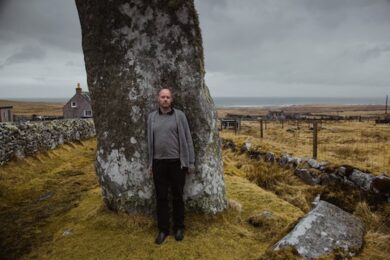


How to parse an album like Beans On Toast With Pythagoras into a snappy, broad-gauge introduction? An album so often multitudinous, so often strange, so often knotty. Recorded in “Norway, Indonesia, Swansea, Kendal, and London”, this geographical separation is evoked by its songs’ mishmash of atmospheres, its pungent combinations of instruments and textures. So far removed is it from common ways of making and releasing music that the sole social media promotion seems to have been, as far as I can see, a few lonely posts on LinkedIn (btw, dudes, a promotional push will not kill you). The album in question, Beans On Toast With Pythagoras, is a fifth studio effort from One More Grain, that shadowy collective formed of Andrew Blick, Robin Blick, Merek Cooper, and international man of action Daniel Patrick Quinn.
Known by few but revered by all that do, One More Grain occupy a tiny, hazy space in the online cultural psyche. Type their name into Google, go back through the results pages, and you’ll see them referenced only here and there: in a Stewart Lee review for The Times in 2008, for instance, or as the subject of a handful of gushing pieces in tiny blogs long since abandoned by their creators, or mentioned in an interview by Polypores who explains how he was once fired from a band by Quinn for not liking Suede (seems fair, mate).
If you’ve spent any time listening to One More Grain then you can forecast the general sonic palette used on …Pythagoras. Like an artist who usually works with one medium, the group tends to adhere to a loose formula of repeated rhythm patterns, a unique lyrical style, and scratchy flurries of treated horns and guitars.
Though this all might sound a bit unassuming, One More Grain share with The Fall a similar alchemical ability to magic totally new, weird, original songs out of nothing more than rudimentary musical building blocks and a bit of Northern English razzle-dazzle. Take a song such as ‘I Want Nine Bollocks (Puck’s Song)’, one of the stand-out moments from this new album: a techno-tinged drum machine beating a metronomic tattoo is plonked under a cyclical horn riff, an icy one-note bass synth chug, and a single vocal motif repeated ad infinitum with a few funny digressions, and, hey presto, you have something to which you’d be hard-pressed to find a meaningful comparison. PSA, incessantly saying the phrases “Davros”, “I want nine bollocks” and “vinegar and brown paper” will not endear you to the other members of your household.
Quinn, writing for the Quietus, identifies how “it is actually considered a minor insult to copy the tuning of one gamelan set exactly for another so no two sound exactly alike.” In this spirit, their fourth album is not a carbon copy of what has come before. The sound has been given an upgrade, they’ve tightened the odd washer here and there, changed the oil, resoled it, updated its iOS. For instance, though One More Grain have flirted with dance music in the past – previous song titles include ‘Leg Stomper’, ‘Figure of Eight’, and ‘Doctor’s Bolero’ – …Pythagoras brings this into the present day with some welcome minimal techno flavours. Clock the thumping kick and syncopated hi-hat on ‘The Barn Dance’, the Warp Records-y IDM scaffolding in ‘The Rig Of The Jarkness’, and the crisp, airless, Balearic beats peppered over ‘Southern’. One More Grain have always maintained a sense of the hypnotic in their music – there’s clearly a debt to stuff like ‘Heaps Of Sheep’ by Robert Wyatt or ‘Afrodisiac’ by Fela Kuti – and the use of motorised, electronic percussion allows a new dimension into their own brand of primordial groove.
In literature written for Gunung, the organisation promoting “high-level thinking” and “new perspectives” of which Quinn is director, phrases like ‘core techniques’ and ‘deeper meaning’ are mentioned. It’s a sense of fundamental force that is also present in One More Grain’s unwavering devotion to the drone as a musical elementary unit. The drone acts as a life source or prime mover for the whole album. Indeed, Quinn reportedly holds chord changes as “overrated”. Despite the songs often seeming rough-hewn, held together with fishing line and a surreptitious twist of electrical tape, this elemental pulse acts as an anchor in such a way that makes the arrangements seem to breathe.
Of course, as with all non-instrumental music Quinn is involved in, gnomic pronouncements pepper the music like trees on a mountainside, with the listener typically dropped in media res amidst a monologue on a certain subject, such as “do I turn left here?”, “keep yer eyes on Pythagoras”, or “I dream of Jeannie”. He’s a commanding, if solitary, presence – one might imagine Robert Macfarlane going to visit him (like he did with Richard Skelton) in Java or the Outer Hebrides, sampling his teabag wine, then writing a chapter on him. On past records, his vocals have sometimes seemed to fight with the music, even sitting at odds with it, but on …Pythagoras his lyrical motifs are repeated, chant-like, in a way that makes them become part of the drone itself rather than a focus of the song. Utterances run throughout each song like strange messages in a stick of Brighton rock. They range from the offbeat, “I want nine bollocks”, to the mysterious “the oldest thing in England”, to the poetic and eldritch “old woman sea and old man stone”. By the end of each song, after imbibing their potent abstractions, you’ve fallen under their mesmerising spell, and feel you almost know what they mean. Almost.
Quinn writes for Gunung that “in the fields of creative arts, we are not always aiming for a song or story or painting to be true or logical but rather be of incredible aesthetic value.” These mantras that Quinn intones can seem chosen as much for their very sound, their ‘value’, as for their meaning. His accent is rich and modulated. Words like “dummy” and “been” are almost chewed up and tasted, with each syllable a fresh new flavour. Likewise, the particular nervy insistence of a drum machine, say, or the rasp of a medieval cornettino, recorder, or euphonium (the Blicks play a lot of instruments), or the pleasing rotundity of an electronic bloop is luxuriated in, and so repeated. In short, particular ideas – motifs, grooves, melodies – are realised in full and carried to a natural conclusion.
Quinn’s idea of ‘incredible aesthetic value’ is perhaps best exemplified by the songs that end with a small instrumental coda. Gunung specifies the use of oblique strategies as a way of breaking creative moulds, and these passages include unabashed expression that runs in contrast to the album’s militant adherence to the drone, the refrain, the rhythm; you pigeon-hole One More Grain at your peril. A small orchestral movement concludes ‘The Yes Set’, redolent of a Christmas brass band playing in a deserted square, while ‘the Oldest Thing In England’ ends with a piece that could soundtrack the end of a huge/overblown spaghetti western, where our hero rides off into the dust cloud (you can almost hear the galloping). ‘The Rig of the Jarkness’ finishes with a gorgeous and totally unexpected electronic finale, a Brian Wilson-esque blaze of descending synth chords that seem only fitting to accompany a slow-mo montage of a star collapsing in on itself viewed from the porthole of a departing shuttle. In music that often feels so tangible – muddy, earthy, peaty, piquant – these little moments of transcendence are deployed effectively.
You could see these codas as tributaries of a river or forks in a footpath, suggesting where to go next. Notice also the snatches of laughter, and those moments where shadowy spoken word samples echo beneath the vocals, and inclusions of found sound (the credits note “gates and doors” being played). ‘Southern’ might even be seen as a sister piece to ‘Northern’, a beautiful solo track Quinn released back in 2005. In the same way he identified for tQ that “On many gamelan recordings you can clearly hear crickets, cicadas and birds chirping away in the background, subtly adding their own melodic fragments to this beautiful music,” these intruding, otherworldly, peripheral, IRL elements dislocate it, creating other layers of meaning beneath the album proper, like a spidery network of footbridges between peaks. Perhaps it suggests that …Pythagoras is not a finished, standalone piece of work but a standard that’s ready for reinterpretation.
As Luke Turner somewhat pays heed to in a Baker’s Dozen piece, it seems inexplicable why the gatekeepers of indie ‘cool’ haven’t taken this strange group to their hearts in the same way they have a Pictish Trail, a Jane Weaver, or a Richard Dawson. Perhaps it’s because Quinn and One More Grain are just a bit too strange, a smidge too sly, just on the wrong side of experimental pop. Or perhaps because they have a LinkedIn page. Perhaps they’ll wait another seven years to release an album, or Quinn will stay in Java teaching creativity and climbing volcanoes and being, as one of his friend’s blogs so brilliantly dubbed him, an “extremely odd ball”. Whatever happens, Beans On Toast With Pythagoras will remain as a strange shining beacon in this gloomy and certain age, a will-o’-the-wisp we all might follow up marshy pathways and rocky ascents.