Photo by Bleddyn Butcher
To write about Australianness is a contradiction in terms, as one of the country’s effects is to rob you of all will to put it into words. It tends to be only those who leave that get anywhere near laying out the truth of the place. It’s the case for many of its major wordsmiths over the past decades: Patrick White, Peter Carey, Clive James, David Malouf, Tim Winton, Robert Hughes, as well as for painters Brett Whiteley and Sidney Nolan. The bass notes of the place rumble out and away from the coastal cities, beneath the unforgiving sky, and through an eternal California of the intellect, where addiction is endemic, threat of violence constant, and the blood of all the convicts and all the natives lies in the dust. There is all the quiet horror of the Church, and the contradiction – through the sheer distance itself – that Australia enforces between these conditions and their universal expression. It is a country unable to conceive of its own viciousness. I grew up there and left as soon as I could. It is hard to give these ghosts their names.
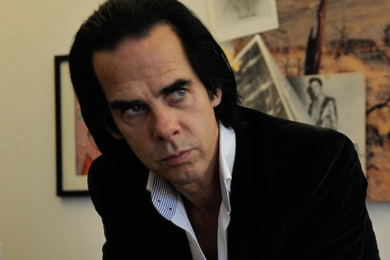
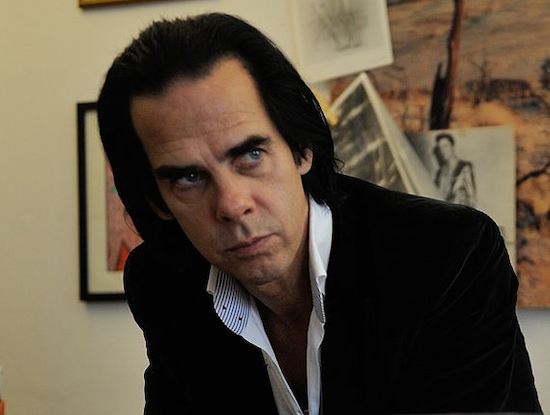
Nick Cave left himself, 22 years old in 1980, to move to London with The Birthday Party. He has said in interviews since that above all he calls himself an Australian artist. His work as a songwriter and author is concerned with giving the ghosts not only names, but clothes, lovers, homes, and stories. The Australian journalist Mark Mordue’s new biography of Cave’s early years, “Boy on Fire: The Young Nick Cave” looks for their provenance through rural wheat-belt Warracknabeal where Cave was born in 1957, to between the cathedral and abattoir across-state in the larger town of Wangaratta, and through Cave’s boarding school, brief flirtation with Art school, and the run-down backstreets of Melbourne that weave behind the legendary punk venue the Crystal Ballroom. Cave says “the potential to both paralyse and energise the ghosts of the dead [is] one of my themes, man!”
The premise of Mordue’s book is that a life’s drapery has as much to do with what one does all day in the earliest summers as the places and drugs one chooses for oneself later. Cave seems like he arrived to us fully-formed on a burning cross, so this Portrait of the Artist is at many points deeply moving, even if, as an early roadie for the Boys Next Door characterises his background – along with Phil Calvert, Mick Harvey and Tracy Pew’s – as so “close to peerage” as to be “a bit like Hugh Grant.”. Cave’s mother Dawn, who died last September, says as an 8-year-old he was fixated on his grandmother’s big black Bible. After they moved town to Wangaratta, his bedroom was next to his little sister Julie’s, and he would yell horror stories to her through the wall at bedtime in return for hot cocoa. Mordue shows us that the path the lyrics of Red Right Hand wind through Wangaratta, “take a little walk to the edge of town / and go across the tracks / where the viaduct looms…past the square, past the bridge / past the mills, past the stacks”. It is here Cave loves the first records he loves: Cohen’s Songs of Love and Hate and John Lennon’s Plastic Ono Album, in his friend’s sister’s sunroom. The groundskeeper at the cathedral remembers him in the choir.
These early rope swings and tin sheds and the hissing cicada-filled lawns undergirding Australia’s man in black is a wilful antidote to the idolatry tradition in which the two previous biographies of Cave sit, from 1996 and 1997. These busy themselves with set-lists and drug stories (Cave’s mic, on stage, not earthed properly; Cave too strung out to notice his continual electrocution). While he can’t really believe he’s been allowed to write this book, Mordue is himself wary of Cave’s mendacious charisma and hostility towards journalists, his propensity to lie. Across his youth Cave was equally loved and hated. Many of the quotes Mordue employs are from emails, and are indexed, but to the point that the second line of the book is footnoted. In so doing the work resists the hagiography trap – often reviews of Cave’s gigs talk of the ‘disciplines’ in the audience – but instead it feels a bit like there’s homework.
Here we are though, in the balance between the gentle and the berserk. The Boys Next Door play their first gig in in August 1977 in the Church hall in the suburb of Ashburton, over which Mick Harvey’s father Reverend Arthur Harvey presided. The Reverend gave permission. There was a brawl. Cave at this point is very into Bryan Ferry. That year, the two big punk bands in Australia at the time, The Saints and Radio Birdman, made the inevitable passage to London. The Saints have just been on Top of the Pops when the Boys are signed by new punk label Suicide. The Boys Next Door make good use of the vacuum left, and they cover Lee Hazlewood’s ‘These Boots are Made for Walkin’ on Australia’s version of TOTP, Countdown, to an audience of serene 12-year-olds.
Afterward, we come through to St Kilda, the home of all the bacchanalian “whoring and scoring.” Cave has been kicked out of art school for not turning up and – not arsed with the hoo-ha of canvas stretching – painting one picture after another on the same thickened old one. He is 19. A music journalist by trade, it is here Mordue gets into gear, and in squalor of the Crystal Ballroom The Boys Next Door coagulates. We meet the managers and the sound engineers and the label bosses and their girlfriends, not all of whom have fond memories of him. Anita Lane’s quiet genius bobs in and out in her pajamas. Tracey Pew jacks a lot of cars, and Cave climbs out of them at speed and as Rowland S. Howard says, would “just hang there like a big black spider.” Rowland S. Howard brings in his Fender Jaguar and his Television records and writes The Boys’ first Big One, “Shiver”, a quiet howl in the great Australian balladeer tradition. Mick Harvey nurses early resentments, and, pre-AIDS, everyone cosily shares the same blunted needle. Tom Waits slinks through the St Kilda Café in 1979 on his tour for Blue Valentine looking for trouble, while the proprietors drilled holes in the spoons out of desperation.
It is well known that the death of Nick’s father Colin in a car accident when Nick was 20 is a tragedy central to Nick’s life and work. Birthday Party drummer Phill Calvert lived three blocks away when it happened:
I caught a tram to his place. I went through a little gate into the backyard and up to the back door. I could see Dawn and Julie through the window, and all these guys in suits. I went in and said, “Hi Mrs Cave.” Dawn said, “Oh Phil, we’ve had some bad news. Colin has been killed in a car accident… All I could say was, “Is Nick around?” I was just overwhelmed…Dawn sent me upstairs. I found Nick in his room. The first thing he said to me was, “Let’s get out of here. This is doing my head in.”‘
A spirited educator who believed in the liberatory potential of lifelong learning, Colin initiated Nick’s literary experience when he was 12 with Lolita, Crime and Punishment, and the “unbelievable body-count” of Titus Andronicus. He also asked Nick what he was doing to make the world a better place and improve the lot of fellow man. Nick had an antagonistic relationship with authority and his peers, and bailing him out tested Colin’s conciliatory strengths. At the time of his death, Nick was awaiting a trial and nursing a slash to the hand after his involvement in the mysterious theft of a red velvet chair. In all, the books Colin left him were a kind of sublime probate. Cave credits his dark romantic vision of the “artist as criminal outsider” to Dostoyevsky. “It was really the first bit of philosophy I could get my head around,” he says, “and it probably inspired me to be an extraordinary arsehole all my life.”
On arrival in London, Nick says the Boys Next Door “made the unpardonable error of playing to the thinkers rather than the drinkers.” Mordue pits Cave against what might be the drinkers – the bourgeois-folk sentimentality of Paul Kelly et al, who’s “fresh sense of home” runs counter to Cave’s abstractions, which “came from somewhere else – it seemed like the opposite of home to him, and yet everything he wrote was dogged by home’s shadow”. Cave would spend much of the coming decade demolishing past efforts in the wake of his latest creation, Mordue says, “wiping the slate clean to exist in a perpetual Year Zero.” Yet he goes back and again to the source. He says himself that with his 1989 novel And the Ass Saw the Angel, he was really trying to write about Australia, not an unnamed place in the American South. “Something akin to Johnny Cash’s romantic, if threatening, stoicism was native to the local character of many Australian towns,” Mordue explains. He funnels his troubled identity fable through the language he’d picked up off Faulkner and Flannery O’Connor. The myth of Ned Kelly, one of Colin Cave’s themes, Colin himself, and the brutal character of the country herself emerge as recurring players that circumscribe what might be called Cave’s Australian Gothic.
But the events of the book were over 40 years ago. While Mordue takes the “idiot savant” designation apart, Cave is aware of, in control of, undoing and redoing his myth. There’re the crosswires of solidify the titan while writing himself as the embittered elder – a task that maybe started with Grinderman. After the release of the album Carnage with Warren Ellis last year, and the filmed solo live performance at Alexandra Palace, Cave is next to act in an ‘online theatre production’ called Dream. He has an online store, Cave Things, where one can purchase a mug that says ‘Suck My Dick’. In 2017 he was awarded the Order of Australia, the country’s highest honours. A book about his childhood and last year’s exhibition in Copenhagen of the ephemera his wife Susie has kept under the bed all these years. Cave is getting older.
Biography is a predatory exercise and the biographer must be able to bite. Mordue neither commits to writing himself into the work, appearing only in the opening and closing section, interviewing present-day Nick on his way to an event. But he asks Nick midway through the book in a blithe rhetorical interlude: “Did you forgive your father, Nick? Did you forgive yourself?”. There are tentative passages of narrativisation but on the whole the book reads as an extended profile in the Saturday paper, however tender and masterfully-researched. There is some baggy license, like the parallel drawn between the love triangle in Goethe’s The Sorrows of Young Werther and the one Rowland S. Howard found himself in, which wrote the lyrics to ‘Shiver’. Cave loved Pere Ubu and Alfred Jarry in the late-70s, and Mordue uses the “savage God” WB Yeats spoke of after seeing Alfred Jarry’s Ubu Roi in 1896 to talk of Nick’s own Christian derision.
Mordue’s book was eleven years of stops and starts in the making. As he tells us in the opening pages, while the larger project he had set out on of a full biography of Cave was derailed by the death of his son Arthur in 2015, it had already “long unravelled as the quantity, quality, and depth of Nick Cave’s output overwhelmed me.” Tobsha Learner, a Melburnian writer and early habitue of the Crystal Ballroom, remembers that in the late-70s it was already evident that “Nick had a narrative for himself… you knew when you were watching the runaway train pulling out of the station even then.” It is the case that biographies are true about their subject most when they’re also about their author. When Mordue writes that Cave’s Australianness betrays “how we undervalue and disguise, and even dismiss what we are as well look outward from our culture for international affirmation”, he as well as writes about himself.
Boy On Fire: The Young Nick Cave by Mark Mordue is published by Allen & Unwin