


Going over old ground here – well this is a hardcore punk reviews column, ho ho – but circumstances, which are invariably bad as things called “circumstances” tend to be, have only cemented my conviction that we do not need songs denouncing Donald Trump. Or Boris Johnson, or any other immoral squatter in their nation’s political chambers. To the extent that there’s mileage in lampooning these swine, it’s ill-suited to song lyrics, particularly in the punk format which tends towards brevity. Media mutates at such speed now (compared to the time of Crass, say, or Pete Seeger) that any angle of attack, or frame of imagery, will have been raked over to the point of cliche.
There is of course the possibility that you’re not trying to create transcendental art, you’re trying to bring about change, in which case I salute your indefatigability and positive outlook! This brings me to the third album by Dropdead, wholesome thrash legends from Providence, Rhode Island. Self-titled like its two predecessors, the most recent of which came out in 1998, and released on guitarist Ben Barnett’s Armageddon label, this is a band which started out when George HW Bush was President and have never been diverted from their path by snotnosed diktats like the one in the opening paragraph of this column. Which is to say that among the 23 songs on this album, there are several broad-brush depictions of Trump’s America (such as album opener ‘Torches’, a tribute to Heather Heyer). Several more, too, of a less date-specific USA, the one functionally broken enough to will ‘Trump’s America’ into existence, and a handful again about factory farming and organised religion, topics on which Dropdead appear to have remained entirely and understandably rigid for 30 years.
Musically speaking, Dropdead does Dropdead with max efficiency and nosehair-singeing fierceness – there’s a minor, stated shift from their 90s incarnation, with frontman Bob Otis making a point of singing decipherable lyrics, and songs run to about one minute on average, although plenty are shorter. Kurt Ballou of Converge (who partnered Dropdead on one of the several split EPs they’ve released since the second album) recorded this with his trademark booming gleam, so it sounds a bit like a Kurt Ballou recording, but less than most Kurt Ballou recordings do. Rest assured that it’s fast as fuck, there are D-beats and blastbeats at various points, and this band remain great ambassadors for a type of hardcore that isn’t especially ‘cool’ but garners wide respect for being staunch in its goals and faultless in its honesty. Due to the vagaries of trying to press records in the ‘rona era, the vinyl issue of this is delayed until November, by which point the Democrats might have won the election and made most of the album obsolete. (That’s gallows humour! Chuckle and move on please.)
Chatta, the second album by Chepang, came out around late spring, but the Give Praise label have just released a CD version and brought the whole thing to my attention in the process, so let’s make up for lost time. Chepang play what has to be some of the wildest grindcore going right now, and though resident in New York are Nepalese immigrants to a man, with vocals in Nepali and a stated commitment to “obliterating borders and nationalism”. Heck yeah.
The main component of Chatta bundles 13 songs into 17 minutes – as with Dropdead, most of those are briefer than the mean – and gene-splices fully feral, lightspeed trad-grind with techy blurs of Escher-level angular implausibility. Colin Marston, whose bands such as Krallice and Dysrhythmia you risk carpal tunnel just listening to, produced this album, and was surely compelled to hat-tip the degree of pointillist extremity on display here. Its chaotic roots – the ‘core of grindcore – are never obscured by the virtuosity, though, Chepang frothing with the enduring spirit of the first-wave Earache Records crew, or even their inspirations. Indeed, much as Siege’s proto-grind 1984 demo Drop Dead (aye) closed with a lengthy suite for noisy saxophone, Chatta both begins and ends with some assaultive free blowing by Mette Rasmussen, a Dane more often found alongside cats like Chris Corsano and Paul Flaherty. Free folk/improv guitarist Tashi Dorji, who appears to be a mate of Chepang’s, is on here somewhere too. Following which – if you snag this CD version – you get four remixes of album tracks by people who are unknowns to me, with the exception of Marcelo Dos Santos from Brazilian psychpunx Deafkids, and a live set from January of this year which is also on Chepang’s Bandcamp. If you like freaky grindcore you really just need to hear Chatta, though.
Oakland crust lords Isotope had an album out last year which I bailed on reviewing, but which was definitely a stonker. I know so because I’m listening to it right now, forming as it does part of a self-titled cassette (on the Carbonized label) collecting all the band’s recordings from 2014 onwards. More lost-time up-making from me, in other words. Isotope’s five members stem from a fairly disorderly bag of punk and metal bands, but formed in 2014 with the purported intention of imitating Japanese hardcore icons Bastard. As is often the case with these kind of hyperspecific projects, they’re of limited value as an end to themselves but a good jumpoff point, and while Bastard’s unhinged, metal-plated bombast permeates the first Isotope recordings (demo tape Final Wind Of Mercy, irritating cod-Engrish title and all, plus a two-song 7-inch from 2015), the addition of guitarist Kristen Payne to the group seems to have been a catalyst for something tighter and vaster in scope.
The four-song Wake Up Screaming EP, released in 2017, thunders out the paddock with the double-tracked vox of Chuck ‘Zone Tripper’ Franco (sidenote: who does one speak to about acquiring a nickname like ‘Zone Tripper’) and Discharge-tastic wailing solos on the title track; it ends with a cover of Anti-Cimex’s ‘Only In Dreams’ which ramps up its Motörhead factor to glaring levels. Isotope, the 2019 LP, reprises a few of their demo songs but is a ramp-up of the up-ramping, Payne and founding guitarist Nick Cantu leaning into some NWOBHM-y tones and ‘Bloody Dove Of Peace’ galloping at the tempo of first wave thrash metal. Fifty-three minutes of this band – the tape’s running length – is maybe too much of a good thing, but, like, that’s kinda how discography comps work, and Isotope are a good thing.
Trekkin’ downstate to Los Angeles, there’s more catching up to do with the release of Rolex’s eponymous 7-inch – or “All the songs from the R through X tapes but re-recorded and faster”, to use the title on their Bandcamp page. This refers to their slightly odd dripfeedy gambit of issuing five two-song cassettes, each titled after one letter of their name, over nearly two years; I did check in on a couple of these, but with little at a time to sink one’s teeth into, it’s taken this ten-track collection on Richmond label 11 PM to get me hopping.
Rolex play the sort of hardcore that sounds like when the nerds go aggro: squiggly, high-pitched guitar swerving perilously across the slightly stouter rhythm section, a vocalist (Khidhar, no surname given) having conniptions in a gruff screech and lyrics which lack a precise thread but never sound more from the heart than “Do you think I’m smart? Tell me that I’m smart!” (‘Hip Intellect’) There’s something of pre-album-era Minutemen in Rolex’s restless complexity and wrangling with life’s nonsense, likewise trippy, supersonic-paced American successors such as United Mutation and 2k10s wackjobs from Warm Bodies to Coneheads, but the carousel retains more than enough room for this particular quartet.
Have to give Rolex extra credit for placing 13 minutes of music on a 7, something done with increasing rarity these days despite it being comfortably achievable. To wit, Háború És Fű (Mindig Otthon Punk Discs) by Norms from Budapest: seven songs in just over nine minutes, flattened onto 12 obscene inches and using as much surplus petroleum as a Qantas ‘flight to nowhere’ in the company of the worst people in the entire world. Maybe even more. I can’t stay huffy with these Hungarians, though, because they have turned in some inspired HC speedsplatter here: at least as eccentric as Rolex, and drawing from the same well of wonky 80s thrash, but ladling on extra feedbacker blur and pretty much reaching grindcore tempos on occasion (e.g. closing number ‘Miről Szól’). There’s a faintly ludicrous cowbell on nearly every song, which doesn’t so much give Norms a slinky disco element as sound like someone trying to commence a speech at an especially violent wedding, and I can only really get a flavour of what the lyrics are about but there’s some stuff about work/leisure conformity, surveillance culture and the Transformers movies, for some reason.
I’m Pretty Sure I Would Know If Reality Were Fundamentally Different Than I Perceived It To Be is my favourite title of any release for some time, not least for its ‘statements that precede unfortunate events’ vibe, and Laura from Xylitol writes lyrics which maintain that title’s momentum and then some. This six-song 7-inch – the group’s second, on the never-not-hot Thrilling Living Records – is a rave on every level! From Olympia, and part of a family tree of (predominantly) queer/trans hardcore groups including G.L.O.S.S., Physique and Cyberplasm, Xylitol play delightfully pockmarked pogopunk with solos sculpted from pure distortion and blunt noisecore bass blat: a catchy racket, mind, not unlike Lumpy & The Dumpers or Thrilling Living roster buddies Sniffany & The Nits.
Meanwhile, Laura (going by Lord Goat here, though I have my doubts this is a nickname which evolved completely organically) sings a bit like a carrion bird of some kind, if a carrion bird busted out audacious rhymes, machine-gun alliteration and metaphysical mashups which portray the vocalist as puppetmaster of the very universe. They’re also funny as shit. You could wang a dart at the lyric sheet and likely hit a doozy, but matters peak with ‘Crazy Frog’, a turbofrothing stampede worthy of the micropenised ringtone reptile himself. “ROTTEN WORLD’S A LOWLY PINTGLASS OF CURDLED EGGNOG / LIVIN’ LIKE A PANTING LOONEY ABSOLUTE SHEEPDOG.” Truer words were never spoken. Oh, one more thing: not sure when/if hard copies of this are gonna reach Europe, but “All proceeds from this record benefit Black Fem Defense, a Baltimore-based organization that makes self-defense tools and training accessible to Black queer youth”, so turn out your purses you lazy hogs!
Once Again The Present Becomes The Past (Iron Lung) is the second LP, and third release overall, of 2020 by Alien Nosejob, so that deserves a review I guess. No, that doesn’t apply to your more prolific but less good project. ANJ is a single Australian, Jake Robertson, who also plays or has played in several Victoria-region bands – the best known probably being Ausmuteants – and, while in solo mode, makes a virtue of changing genre as often as he pleases. That said, while this approach has found Robertson in psych, garage and synth pop mode to date, Once Again’s brisk, trashy melodic hardcore continues down a road first travelled on HC45, an EP released by Iron Lung early this year.
On account of this album being wholly self-performed, recorded (on a reel-to-reel, no less) and mixed (Mikey Young of Total Control mastered it, but it’s a government-mandated requirement that he masters every Australian underground punk record), there’s a lo-fi slenderness to the sound, even when a song like ‘Pointed Shears’ gets its superbly chugging bassline crowded out by a zit-poppin’ heavy metal guitar solo. Robertson is not shy of adding keyboards, whether in the context of beatless instrumental piece ‘The Day After’ or jittery Devocore goofs such as ‘Present Becomes Past’. ANJ’s type of hardcore, you feel, could as accurately be seen as hulked-up new wave, going on the likes of ‘1984 Once More’ – whose title also nods towards this album’s loose theme of totalitarianism, war and the ease with which either might reenter the fray.
“Pull over/ Got the 8-track tape/ Keith Emerson/ Greg Lake.” I know I was going on about great lyrics back there, but those are… well, they’re lyrics too. They’re from ‘Shake Rag’ by True Sons Of Thunder and I wouldn’t change a word of them. First song of three on this Memphis ensemble’s Age Old Effrontery single (Goodbye Boozy), ‘Shake Rag’ is like Flipper’s ‘Sex Bomb’ if Flipper had been a 90s Crypt Records band – guitarist Eric Friedl is also a longstanding member of The Oblivians, thus making this notion flesh – and drops in a faintly comical phaser effect towards its close. It’s belting crud-rock, textbook stuff for the tipsy-into-sloppy transitional phase. ‘Plastic Bat Attack’ is a crunchy stop-start-flop noiserawker enlivened by a freeform squealing solo that I honestly can’t tell if it’s guitar or sax-shaped; ‘Toob Sock’ has the length (76 seconds), pace and informality of hardcore, although reminds me of a band like Mondo Generator for some reason. While True Sons Of Thunder are probably not quite as old as their ELP-referencing lyrics might infer, they’ve definitely done their time, and they make it work on a release that sounds like facial crags and truckers-speed jaw ache in equal measure. LP on Total Punk extremely imminent, also.
As with a lot of anthology compilations of punk obscurities, this self-titled LP by L-Seven has been around a decade in the making, albeit not exactly a full-time concern across that whole period. Apparently, it was a hobbyish sideline of Steve Shelley from Sonic Youth, who was an acquaintance of the early-80s Detroit group in his pre-SY days and who gave his small archive to the Third Man label so they could bring it to fruition with salaried efficiency. Fair play to all involved – this is a worthwhile historical spotlight on a band who released six minutes of music in their lifetime and are invariably accompanied by a parenthetical note to avoid confusion with LA grunge band L7.
Moreover, L-Seven have been defined and damned by their links to better-known hardcore institutions, despite playing in a pointedly non-hardcore style. Their first and only single (reissued separately next year, FYI) came out in 1982 through the Touch And Go label, which would diversify shortly after but was then so dedicated to pushing a certain brickwall sound – Negative Approach, the Necros et al – owner Corey Rusk gave the gloomy, Anglophilic postpunk 7-inch its own subsidiary. Negative Approach frontman John Brannon and L-Seven singer Larissa Stolarchuk became a couple, forming Laughing Hyenas in the mid-80s while sinking into a shared heroin addiction that would eventually claim Stolarchuk’s life in 2006.
L-Seven is dedicated to her memory, reasonably, and its 13 songs – one side of demos from 1981, one of (good quality) live recordings which concludes with sprightly Misfits and Yardbirds covers – mark her out as the ghostly, powerful figurehead of a consistently interesting band who twisted influences in striking ways. ‘Flowers Of Romance’ signposts the band’s PiL fandom, albeit without really sounding like them; ‘Brixton Shuffle’ appears to be hailing, if not emulating, 2-tone’s then-new multiracial bounce. There’s lyrical sax and singsongy vox a la Essential Logic on ‘Lost In Paradise’, scratchy dub moves on ‘Klickety Klack’, while the ‘82 live songs are Slits-type bursts of rhythm at some points, swirling and gothy at others. L-Seven supported pretty much every droppable post punk name who hit town – U2, Bauhaus, Gun Club, Banshees – and might have grown into something comparable (discounting U2, perhaps) given time, but knocked it on the head right after opening for The Birthday Party in 1983. So it goes.
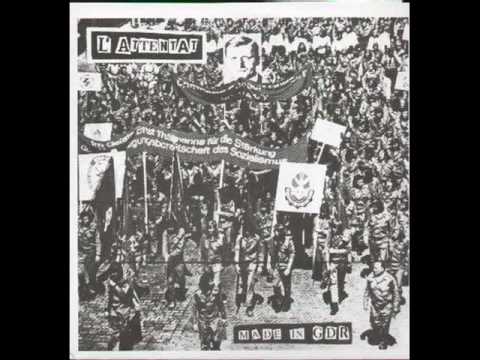
And if you suppose something like the above was tough to pull together, the Too Much Future box set is next level. The introduction to the laudably extensive book that’s included cites the publication of Jon Savage’s England’s Dreaming as the compilers’ initial spark – 29 years ago, in other words.
Released by on a label named Iron Curtain Radio, it’s subtitled Punkrock GDR 1980-1989 and collects two hours’ worth of East German scuzz right up until the Berlin Wall toppled and the circumstances that defined this music began to fade. Fundamentally, these bands were illegal and in some cases copped punitive punishment: members of East Berlin’s Namenlos were all jailed in 1983, Magdeburg’s Vitamin A in 1986. Almost none have released music outside of (literally) privately circulated cassettes, and were largely limited in how much of the global scene they could absorb, which arguably lends a regional uniqueness akin to a lot of South American punk from the same decade.
Like a Bullshit Detector compilation, or any random cassette sold through NME’s classified ads in 1981 or so, there are some truly shit-fi primitive herberts peppered through Too Much Future. The title of Unerwünscht’s contribution, ‘Oi Oi Oi Destroy’, might be instructive here, but amidst perfunctory gluebag grunters like them, Betonromantik or Schleimkeim, a few bands – Zerfall, Andreas Auslauf, Paranoia – try hardcore tempos on for size. Further, there lurks inspiration from Konstruktives Liebes Kommando, total Messthetics gold high on backfiring Trabant fumes; Bogshed-esque spasms from Torpedo Mahlsdorf; mental noise-folk ranting from Virus X, who sound like nothing I’ve ever heard; and the psych-swirling bludge of Müllstation, one of few acts here to have a significant post-unification career.
A lot of these bands melted into the shadows after finishing, not surprisingly, although compilers Maik Reichenbach and Henryk Gericke are both very much scene veterans. Ronald Lippok and Bernd Jestram, two members of taut postpunks Rosa Extra, made the jump to noodly electronica in the 90s as Tarwater, and the big riffs of Die Frechheit’s ‘Rockerfeller’ are backed by the drumming of Christoph Schneider, who’s spent the last 26 years enjoying that sweet post-communist freedom as a member of Rammstein.