

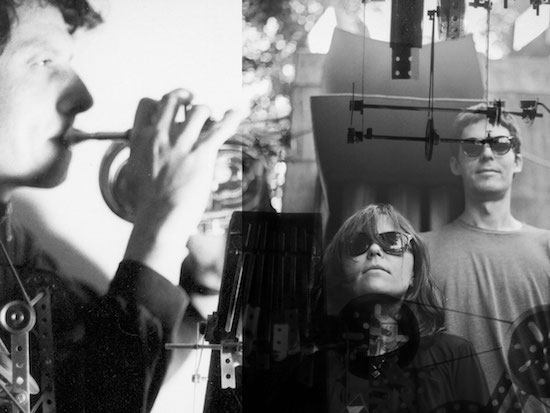
Right now there seems to be more focus than usual on France’s richly variegated post-68 musical landscape. Warren Hatter has done a superb job on this site of suggesting conceptual and musical frames that might help the listener to get a handle on this nebulous ‘scene’ (if such a term is even appropriate). A catch-all term still proves elusive, though – in the first ever Rockfort column, I mentioned the ‘rock choucroute’ – ‘choucroute’ being the French translation of sauerkraut – but that would seem to confer secondary status on French artists relative to the German pioneers of the same era.
At the same time, enter Finders Keepers with their new compilation, Strain, Crack And Break: Music From The Nurse With Wound List Volume 1 (France) – based on the list of avant-garde heroes originally found on the sleeve of NWW’s 1979 album Chance Meeting On A Dissecting Table Of A Sewing Machine And An Umbrella. A brilliant primer for the freakouts, rugged electronics, wriggly jazz and absurdist vocalisation of the period, it also points to the French bands’ interaction with and responses to wider British and European musical and political currents – the intensely zany Etron Fou Leloublan were affiliates of the Rock In Opposition movement founded by the UK’s Henry Cow; Dashiell Hedayat’s ‘Fille De L’Ombre’ is, musically, the work of UK exiles Gong, while ZNR’s ‘Solo Un Dia’ has clearly sipped from Canterbury’s cup of whimsy.
There will hopefully be much more said directly on the subject, but one of my concerns in these columns has been to demonstrate that the trail hasn’t gone cold. This isn’t just due to some of the key players of the 70s still being active and in fine fettle today, although this is undoubtedly the case – Heldon’s Richard Pinhas, Magma (who, based on show I saw at the Jazz à Vienne festival last year are on absurdly good form), Jacques Berrocal (releasing music on Blackest Ever Black) and Pierre Bastien, who makes an appearance below – but because the questing spirit in evidence on the NWW comp is also very much alive and well in France today. Just to take one example, Mahjun’s ‘Les Enfants Sauvages’: the snaking, folky melody and the somnolent voice of Dominique Barouh (second wife of Saravah label founder Pierre Barouh) echoes through recent and forthcoming releases by Midget!, Arlt (and singer Eloïse Decazes) and Léonore Boulanger. Or even L’Étrangleuse, reviewed below and included in the latest mix, just after Jean Cohen-Solal’s ‘Captain Tarthopom’ from the Finders Keepers release. The next track, the controlled noise detonations of LFant’s ‘Diary’, might not be too out of place in the company of some of the other artists on Strain, Crack And Break either.
The selection also includes more club-oriented sonic invention from producer and DJ Crystallmess and trap-based turns from Luv Resval and Almeria, a steamy new Perrine En Morceaux track and a sliver of film dialogue.
Tomaga & Pierre Bastien – Bandiera Di Carta
(Other People)
&
Papivores – Death And Spring
(Hands In The Dark)
Bandiera Di Carta is the first of two Anglo-French collaborations reviewed here – although actually it’s Anglo-French-Italian since terrific London-based drummer/percussionist Valentina Magaletti, who is also to be found performing with Vanishing Twin and The Oscillation, was born in Bari.
Tomaga – Magaletti and Tom Relleen on bass and electronics – should be pretty well known to Quietus regulars for their frequently tension-filled, near-industrial jams. Pierre Bastien, as mentioned above, is from the generation of musicians that came of age in the 70s. By the time of his appearance playing double bass on several Jacques Berrocal recordings – including ‘Rock’n Roll Station’ in 1976, featuring Vince Taylor on vocals – he’d already begun making various rhythmical contraptions, his first apparently the result of having placed a metronome between a saucepan and a paella pan. He went on to form the anything-goes improvising duo Nu Creative Methods with Bernard Pruvost in 1977, collaborated with Pascal Comelade in the 80s and released two albums on Aphex Twin’s Rephlex label in the noughties. A constant has been the distinctively jerky-but -swinging rhythms created by his custom-made devices and his evolving mechanical orchestra – the Mecanium – and his trumpet (often water trumpet) playing.
The recording grew out of meetings at Fructose in Dunkirk and the Supersonic festival in Birmingham, and the Italian title (‘paper flag’) is a reference to Bastien’s paper-and-air sound machine but also the erasure of national and musical borders. It’s not only a satisfying alliance but also an intriguing one for the new light it sheds on Bastien’s sounds particularly. Bastien’s music, and his live shows, delight in contrast and juxtaposition, and are dreamlike in a slightly jarring but ultimately delightful way. Closing track ‘Circles In The Ruins’ and ‘Paper Ritual’ (which sounds like it features the aforementioned paper-and-air machine) come closest to that feel, but ‘Senza’ places him in a creepier context, his tick-tocking suggesting the exposed spine of a lumbering creature. Magaletti and Relleen work wonderfully around the skeleton he provides, providing shading, locking in step or deftly building up polyrhythms.
Violinist Agathe Max, originally from Lyon, currently lives in the UK and is working on a number of ongoing projects including Kuro with Bristol-based Gareth Turner (of Anthroprophh) and Mésange with guitarist Luke Mawdsley, as well her own solo work – check out the gorgeous Rêves Perdus from earlier this year. Papivores sees her team up with – yes, him again – Tom Relleen and also references paper – their name literally means ‘paper eaters’, although the word is more commonly used in French to describe avid readers. Furthermore, the album (released by superb French label Hands In The Dark), takes its inspiration from a novel by Catalan writer Mercè Rodoreda (which has been translated as Death In Spring).
Papivores’ responses to the text over the five tracks here are intriguingly varied. First track ‘Heard By Stones’ sounds as though it features actual stones being scraped and slid over a surface (and across the stereo field), rippling layers of vibraphone (I think) and jittery pizzicato strings, while ‘Forest Wisps’ is centred on a rapid technoid pulse around which effected breaths and Max’s violin swoop and swerve. ‘Poupre Reflects Glace’, meanwhile, is nearly 14 minutes of elegantly mournful minimalism, electronic and acoustic textures trailing and folding into each other.
Palm Unit – Don’t Buy Ivory Anymore! The Music Of Henri Texier
(Komos)
Last time Lyon’s Palm Unit appeared in this column it was with an album tribute to cult French jazz pianist, producer and critic Jef Gilson. On Don’t Buy Ivory Anymore! they’ve shifted their attentions to Henri Texier who, unlike Gilson, is alive and well and still playing bad ass double bass. The group seem to be mapping a family tree of late-60s and 70s French jazz – Gilson, incidentally, produced the second album by Jacques Thollot, whose ‘Cécile’ the NWW compilation includes and, in 1967, brought Texier into his band, by which time the double bassist had already established himself as one of the earliest exponents of free jazz in France. Texier also paid his dues working with singers including Charles Aznavour, Jacques Brel, Sacha Distel and Catherine Ribeiro but his two most widely appreciated albums, the solo recordings Amir and Varech (which came in 75 and 77 respectively) were something else entirely. Multi-tracking himself on a Revox tape recorder to add oud, percussion and wistful, wordless vocals to his double bass and, he created a unique sound that fused folk, jazz and traditional North African music.
Unsurprisingly, a number of the pieces reimagined on this, one of the first releases on new Paris-based jazz label Komos, are drawn from those two albums – the best-known, ‘Les “Là-Bas”’ from Varech has been remixed by Bonobo. Palm Unit’s treatment seens Texier’s vocal line taken by Fréderic Escoffier’s Farfisa organ, with rubbery bass synth teasing out the funk, while their version of the aqueous ‘Homme Rouge’ from Amir bubbles up with an unexpected intensity, spurred on by Lionel Martin’s powerful jets of tenor sax. They push even further on ‘La Compaňera’, from the 1983 Henri Texier quartet album of the same name, turning a rather pensive number and injecting it with diabolical energy.
L’Étrangleuse – Dans Le Lieu Du Non-Où
(La Curieuse)
More action from Lyon in the shape of this duo who play harp (Mélanie Virot) and guitar and Malian lute/jelo n’goni (Maël Salètes, also of Orchestre Tout Puissant Marchel Duchamp) and sing, sometimes in unison, sometimes in overlapping and interlocking lines like a folkier Stereolab. This lovely third album, following the John Parish-produced Memories To Come from 2015, continues in the same trancey vein but, with sound engineer Sébastien Guichard, they’ve arrived at a warmer, less brittle sound, filled out with occasional percussion (‘Silence’) and discreet electronic touches (‘Coïncidences’).
Like compatriots Stranded Horse they forge links with West African folk, but with a more ragged-edged, Velvets-like energy. Salètes’ guitar or n’goni and Virot’s sometimes-distorted harp circle each other, with the latter occasionally – such as mid-way through ‘Bois L’Eau’ – rising and rolling in crystalline waves across the songs’ surface.
Pion – 22:22
(Entreprise)
The Entreprise label has, with artists like Fishbach and Grand Blanc, and Jérome Echenoz’s ‘Le chrome et le coton’, been best known as a purveyor of somewhat knowing, 80s-inspired pop, a sort of indie variété. But at the same time there’s been the sumptuous psych of Moodoïd’s debut album – oh and a group of oddballs called Blind Digital Citizen, who released two EPs and an album’s worth of agitated, rave-powered chanson before disappearing.
Or perhaps not. Three of that band’s members, Louis Delorme, François Devulder and Charles Templier, are in-demand musicians who have worked with Charlotte Gainsbourg and Air, and they’re also the core of Pion. If anything, the nine tracks here are even tougher to get a handle on than those of Blind Digital Citizen – sometimes they recall the proggy pop-rock of Feu! Chatterton (as on ‘Déluge’), but single ‘Coca-Loca’ turns itself every which way and inside out over five and half minutes of disco punk and (eek!) nu-rave, with the title chanted like the “ooga-chaka” intro to ‘Hooked On A Feeling’. ‘Sympacide’ is equally bats post-punk-meets-prog, and ‘Peuple Fossil’ builds from an ambient wash of synths, sad robot voice and tremolo-tweaked guitar to a thundering, stadium-sized gallop. I honestly have no idea whether, in a couple of years’ time, I’ll consider 22:22 a work of genius or find it utterly unlistenable, but it’s anything but dull.
Horla – Fantômes
(Le Cabanon)
Horla aka Clovis Lemée is one of the founders of the Le Cabanon label, founded in 2013 but currently initiating a new series of LPs. Fantômes, Lemée’s first album under the Horla name, was recorded over two years in the countryside in North-Eastern Madagascar, where he lives and cultivates cocoa to produce chocolate.
Fantômes ’s themes are an intoxicating mix of the natural and the supernatural, perhaps with drugs mediating between the two: a little ‘Haschich Jazz’ here, an ‘Opium Quartet’ there, mixed in with references to water, rocks and coconuts, or to ghosts and les morts. Equally his productions are mid-way between the organic and the artificial-sounding, the humid and the bone-dry – the first sound you hear on ‘Opium Quartet’ could be a recording of the wind, clipped and reversed, sucked backwards. The beats on many tracks sound like they’ve been melded from a combination of digital technology and live percussion. And through the lazy, incantatory rhythms, metallic chimes and sighing synths you can almost visualise one of Lemée’s trips by river to search for new ingredients in the jungle.
Lispector – Small Town Graffiti
(Teenage Menopause)

Although only recently welcomed into the Teenage Menopause family (a label that’s also home to the excellent Heimat, UVB76 and Jessica93’s icy grunge), Julie Margat has been putting out charming bedroom pop records since the mid-90s and was the vocalist on The Go! Team’s ‘Ready To Go Steady’ (from 2011’s Rolling Blackouts).
I have no idea whether Margat actually makes records in her bedroom, but Small Town Graffiti is entirely self-recorded and has the hallmarks of that approach – pre-set rhythms and chintzy organ tones; a certain undemonstrativeness; a clear love of 60s pop (check the Motown beat on ‘Be Careful What You Wish For’), 70s soft rock (the Alessi Brothers’ ‘Seabird’ is given a jaunty makeover) and shambling indie (‘Astrologie Sidérale’). And she’s been doing this for long enough for the album to feel effortless despite being full of craft and embroidered with lovely detail, like the sitar line on closer ‘The Swimmer’ and gurgly backing vocals on ‘Hupper’.
Orval Carlos Sibelius – Smulkios Detalés
(Fondation Arcana)
Welcome back Alex Monneau aka Orval Carlos Sibelius, who has a habit of cropping up when and where you don’t expect him (Smulkios Detalés appears to be the Fondation Arcana’s only release to date), sudden flurries of activity following years of apparent musical dormancy, and baroque, song-based projects alternating with more atmospheric instrumental excursions. Previous album Ordre Et Progrès, on cult French indie Born Bad, was in the former camp; this surprise release falls into the latter and appears to have been deliberately conceived for a cassette release (although it’s available digitally as well). Shimmering analogue arpeggios, milky synth pads, occasional bright slivers of guitar and pattering percussion predominate, although Monneau’s ear for melody clearly hasn’t abandoned him as ‘Politique Des Cookies’’ happy-sad figure demonstrates.
Previous attempts to pin the kraut (or choucroute) rock tag on OCS have been somewhat wide of the mark but many of these 14 tracks have the beautifully warm, rippling feel of Harmonia or some of Cluster’s work, like they’re floating in amniotic fluid – and you with them.
Rockfort! Mix 18
Jean Cohen-Solal – ‘Captain Tarthopom’ (Finders Keepers)
L’Étrangleuse – ‘Vertige Et Vérité’ (La Curieuse)
LFant – ‘Diary’ (Dur Et Doux)
Horla – ‘Haschich Jazz’ (Le Cabanon)
Palm Unit – ‘La Companera’ (Komos)
Papivores – ‘Heard By Stones’ (Hands In The Dark)
Pion – ‘Déluge’ (Entreprise)
Crystallmess – ‘Flesh’ (Country Music)
Luv Resval – ‘Crystal Lake ft Freeze Corleone’ (AWA)
Almeria – ‘Drugs ft Jorrdee, Lala &ce’ (Arista France)
Perrine En Morceaux – ‘Je Voudrais’ (N/A)
Lispector – ‘Huppert’ (Teenage Menopause)
Tomaga & Pierre Bastien – ‘Bandiera Di Carta’ (Other People)
Orval Carlos Sibelius – ‘Ovipare’ (Fondation Arcana)
‘Un Gars Discret’ – Dialogue from the soundtrack to the film Les Particules, featuring music by Èlg (Three: Four)