
When they were young, members of Cabaret Voltaire used to walk up to strangers at bus stops in Sheffield and spray them with sounds from reel-to-reel tape recorders. They wanted to liven up everyday life in a Northern industrial town, and observe what would happened when people were jolted out of familiar habits. This pranksterism sticks in the memory, not just because it speaks to the DIY graft that’s part of Cabs’ origin story, but because spending hours splicing sounds onto tape and then blasting them out for a few seconds touches upon a question lurking over the live performance of electronic music as whole: if all the work takes place in the studio, what’s so special about the show itself?
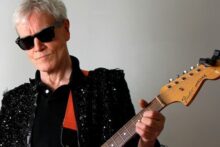
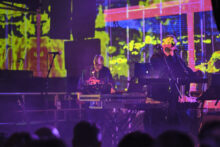
The stakes of their latest tour were, for sure, higher than the usual greatest hits show. Following the death of founding member and figurehead Richard H. Kirk in 2021, the other two components of the original trio, Steven Mallinder and Chris Watson, came together to bring their music back to life on a succession of UK tour dates. Joined onstage by Eric Random and Oliver Harrap, and with engineering and mixing help from Benge, the tour was driven by the feeling that their music had something to say. Their themes regarding the pace and precariousness of technological advance still resonate in the current moment.
This set, taken from their 2025 UK tour, is centred on the early to mid 80s Virgin era of The Crackdown and Micro-phonies, with diversions into the earlier Rough Trade period including Red Mecca. Around this time, the Cabs were harnessing the power of rhythm machines such as the MXR Drum Computer and Roland TR-808, plus the TB-303 Bass Line monosynth, and aligning themselves with dance music, which offered a space of possibility away from the mainstream and the personality cults of pop and rock.
What jumps out straight away is the crystal clear boom of electronic sound through the system, its reverberations around the venue, and the excitement of the crowd who are part of this network. The audience comes alive not when the Cabs play the first melody, but when the first sample is triggered – “24, 24, 24 hours a day”, a promise of availability, or observation – and when the first electro beat drops. Although the live show features Mallinder’s live bass and vocals, carrying some of grit and volatility of the group’s early years and albums like Mix-Up and The Voice Of America, the pace is set by the machines. The cinematic voices and electro beats of ’24-24′ are followed swiftly by the uptempo ‘Animation’ and ‘Why Kill Time (When You Can Kill Yourself)’ as if the computers are rolling out the set in a a pre-programmed sequence.
What the domestic listener hears on this live document is an encounter between the group, their technology, a space, and the people inside it. Like Kraftwerk performances, the creativity is about design, planning and technical execution to set up a virtuous feedback loop, rather than momentary musical inspiration or individual improvisation. And like Kraftwerk, the version of Cabaret Voltaire presented in these performances is a skilful edit of the back catalogue, omitting the mercurial eccentricity of earlier work to highlight the sleek efficiency and symmetrical lines of their expertly sequenced technological prime.
The presence of Chris Watson here is paradoxical but poignant. He left the group around the time of 1982’s 2×45 – from which ‘Yashar’ is the only track included here – and eventual became an internationally renowned natural sound recordist. With Kirk now gone, Watson patches seamlessly back into the CV system to realise music that he was not part of at the time. One new interlude ‘Tinsley Viaduct’ uses some of Watson’s recordings of the bridge in Sheffield to provide closure on his return to the Cabs.
Back in the day, the group’s standard MO was to put as many instruments as possible through synths and effects – their Sheffield studio space Western Works was a repository for all kinds of electronic gadgets, from broken tape machines to the advanced EMS Synthi Hi-Fli effects pedal system. This destabilised the main building blocks of rock music, the guitar and vocals, which on the Rough Trade classic ‘Nag Nag Nag’ are transmogrified into electrified fences and anxious tannoy announcements. A touching side effect of the fidelity of But What Time Is It Really? is hearing for the first time lyrics which were once opaque and polluted. Versions of ‘Yashar’ and ‘Sensoria’ leave a similar impression to Kraftwerk’s modern versions of their songs – they’re distilled, optimised, reinforced.
The thrill of the Cab’s vision is the tantalising, glinting double edge of technology. Tech can craft, cut and connect audio and visuals (the latter via their own Doublevision label) to make new sensory pleasures. But it can also divide and rule, separating groups of people via disinformation, paranoia or fake news. Song titles such as ‘Crackdown’, ‘The Set-Up’, ’24-24′ and ‘Spies In The Wires’ sketch a dystopian present or future, where information is controlled and withheld, and dark revelations might always be round the corner. It’s rarely clear in their work whether technology is being used for good or ill, who are the good guys and who are the bad ones.
If Kraftwerk wrote a multi-part literary epic of technological change via their 1970s albums, the following decade saw the Cabs sketching comic book adventures with ever wilder plot twists. As the cynical 80s made clear, mysterious powers that we don’t fully understand are always working away somewhere in the background, threatening to flip the script. Kraftwerk orchestrated social progress and technological communication into electronic symphonies, but the Cabs are like hackers with their noses pressed up against the wires, punching in drum codes, synth riffs and sampled codewords again and again to try and gain access to a system that’s barely possible to understand in its entirety.
The title But What Time Is It Really? hints at the repetition that’s a part of the Cabs’ music. There’s a faint echo of the closing words of David Lynch’s Twin Peaks: The Return – “What year is this?” – which hint that we’re all just pawns in a game we can’t escape from. But there’s also a cute nod to the old electro / hip hop hype call of ‘What time is it?’, with a wry addition of ‘really’ suggesting the pleasures of the dancefloor have been lost along the way.
This set, featuring two of the surviving members of Cabaret Voltaire, is as clear and powerful as any of the live albums the group released while Richard H. Kirk was alive. And it underlines that, when it comes to the live experience of electronic music, there’s a certain beauty in the way that the system – the grand design – can sometimes outlive its creators.