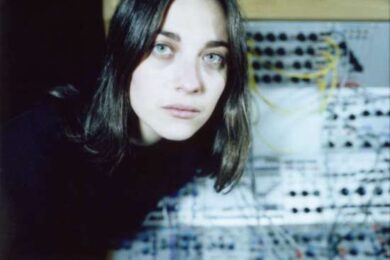

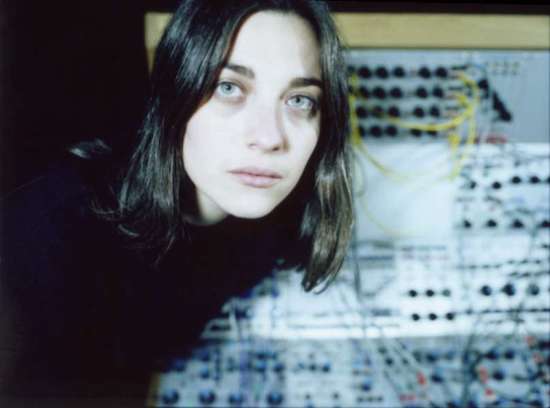
Kali Malone portrait by Victoria Loeb
A month or two ago, while I was in the middle of proofing 80,000 words on obscure coastal sounds tQ Editor John Doran asked me to take up this column. I have come inland from that seaside fog, to put on the shoes Russell Cuzner left behind him in order to march headlong into the forest of Rum Music. This is an arboretum of loose sonics which for my inaugural edition includes the burrs of Hungarian sound poetry, Swiss-made sounds of decomposition, alternative future Malian cities, and Swedish organs.
What is rum music? ‘Rum’ is one of my favourite of the terms used by my Lancastrian mother. She deploys it as a term of affection for the more eccentric personalities she encounters, most of whom are related to her. To be rum is to be peculiar, but in a good way. It is not bad, it is both particular and unexpected. This column got its name because it was originally written by Frances Morgan, and so it became Morgan’s Rum Music, an excellent pun.
Elsewhere this column would be about ‘experimental’ music, but nobody likes that term even though it is a useful catch-all to facilitate communication about the disparate sound worlds we all inhabit and encounter. (One of the problems with the term is that much of what gets qualified under that meta-genre is not experimental at all. ‘We are not experimenting’, a lot of musicians might say, ‘we know exactly what we are doing.’) Avant-garde is better, but tends towards denoting a particular historical period of music in everyday usage.
Underground is more about economics and audience than genre. The fact is, after 14 years writing about this roadside picnic I still haven’t found anything that works for The Zone, apart from to say what it isn’t. But this is my field work, and as The Zone continues to disappear in chunks from the outside in, its invisible but unmistakable boundaries always in flux, I here look to ratify the existence of a handful of scenes, individuals, groups and sounds; they are artefacts of something nobody can see the whole of, myself included.
Various Artists – Seitō: In The Beginning, Woman Was The Sun
(Akuphone)
The Tokyo Flashback compilations of heavy 90s jams on the Japanese label PSF (home of Keiji Haino, High Rise, and other undersung legends) are some of my favourite ever, and this new one on the stellar Akuphone label says it’s looking to that series as inspiration. This volume includes a track by Kiki Hitomi, who you might know as a former member of King Midas Sound and Jahtari dub artist.
I usually pull a face at things that put a simple drum machine beat on otherwise excellent music, but Mikado Koko’s ‘Fukagawa Bushi’ has a sticky groove. The title is a reference to a cult feminist magazine printed in Japan in the 1910s, which in the process of writing this sentence I have Googled and lined up in my reading list as you should also do.
Rudolf Eb.er – h e x e n l a t h e
I was once told a story about Swiss noise artist Rudolph Eb.er, which claimed that while he was on tour all he would eat was sausage spicy enough to make the average person weep. If anyone can corroborate this I’d be glad to hear from you. Actually, scratch that, I like this story too much to risk losing it. Eb.er has been performing and releasing for decades and is best known as founder of the extreme Swiss arts group Schimpfluch (who definitely come with a NSFW warning if you were thinking of googling them in public). That group is a bloodied and vomitous carnival of the grotesque, an easy thing to parody and a difficult thing to watch, but Eb.er’s solo works are slow macabre tunnellings into the earth, definitely not for the taphophobic.
He’s mostly been self-releasing CD-Rs about death and the rituals thereof for the last few years, producing a vast and necrotic sonic imaginary about metaphysics and dying. The preoccupation though is with decomposition, the sounds of insect mandibles consuming something is like staring through covered hands at a corpse set upon by carrion beetles. Om Kult: Ritual Practice Of Conscious Dying – Vol. III was released in March this year, and he’s also bumped out h e x e n l a t h e recently, which comprises turntable rips of an 8” lathe cut originally released in an edition of 30, along with another 7” and a few other bits.
Various artists – Uchronia: Field Recordings From Alternate Realities
(Sahel Sounds)
I have been having a conversation with myself and others about whether traditional but lesser known music forms can be included in a column like this, about the way that ‘othering’ happens by grouping together non-Western forms as music considered different, or not normal. However, this fantastic slab of Afrofuturism on Sahel Sounds is a case for the defence. It makes a radical proposition as a compilation of traditional musicians and contemporary sounds, composed and arranged in an album for a re-imagined future Bamako. It’s a street-level sonic answer to Black Panther, which I can’t believe hasn’t existed until now. It’s not traditional, although it contains traditional Malian sounds; it contains folk music, but it’s folk music about alternate reality. In this parallel Bamako, Abubakari II – a 14th century Malian emperor – discovered America when (as the limited historical records available suggest) he abdicated in order to "find the limits of the [Atlantic] ocean".
It includes music by prominent musicians from the Malian capital such as rapper and producer Luka Productions, Oumou Diabate (who became something of a controversial celebrity at home due to her feminist lyrics) singing a cappella, as well as a gospel rock band, video game music, street musicians, a relaxation cassette and digital samplers.
CC Hennix – The Deontic Miracle: Selections From 100 Models Of Hegikan Roku
(Blank Forms)
Mary Douglas said dirt was matter out of place and my mind is full of thoughts that should not be there, but compositions such as these loosen that unwanted grime and rinse it out with cool water. I would say this release is like a bath, but it’s more than that – like slipping your entire being into the silky green waters of a deep Swedish lake. Truly, nothing makes me happier than lots of really long but slightly different notes, played for ages and ages. If you don’t know Hennix and you do like both US minimalism from the 1960s and Eliane Radigue then grab your cossie immediately, you’re going for a dip.
Most of Hennix’s output is microtonal computer music, where time collapses at the point where it meets a waveform, so that there is a true infinite physics to the whole thing. This music, released on the flawless Blank Forms, was originally recorded in 1976, before the computers that would eventually facilitate her compositions even existed; it stems from a period when she was doing a Theatre Of Eternal Music type turn, but apparently ended up ditching most of her large ensemble of string players because none of them could play a microtone.
Kumio Kurachi – Sound Of Turning Earth
(Bison Records)
It is an assumption entertained by some that every piece of music ever recorded can be pulled from a point inside the vast and spacious eternal data cloud. Not to burst this particular bubble, but it’s not a cloud, it’s a server farm, and also, it’s not comprehensive, not by a long shot. Abby Thomas’s Bison records is here to show doubters a gaping hole in the English-speaking data cumulus of music, with the release of Kumio Kurachi’s Sound Of Turning Earth.
Kurachi has released “11 albums and unknown quantities of cassettes, compilations and split releases” but never one outside of Japan. This one was recorded by Jim O’Rourke (and if you’re a fan of O’Rourke’s solo guitar-ish music you’ll be well into this). His guitar tunings are based on that of the koto and his lyrics are vignettes, the “small events” from life like “the joy of choosing a lipstick in springtime, the business of changing the tatami, raindrops deciding whether to fall as snow”. What a triptych! Thankfully, the CD includes translations of his lyrics, which presents a solid imperative to drop the extra coin on the physical.
Katalin Ladik – Phonopoetics
(Alga Marghen)
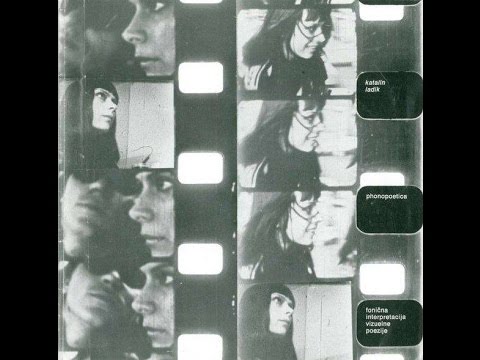
Speaking of language barriers, I also reckon sound poetry is some of the most ‘difficult’ experimental music there is. Language is personal. We create our own meanings. We have accents and contexts and sensitivities and expectations. To take all this complexity, tear it up, and scatter it to the wind either forms a new galaxy of possible sound and meaning which glows in new constellations above our heads, or falls to the floor, ending up like a bag of food recycling that has been mangled overnight by foxes.
This 1976 record by Hungarian poet, performer, artist Katalin Ladik is one that, for me, pulls an important historical thread across the world, from New York to what was then Yugoslavia (she speaks Serbian and Hungarian). She sounds in thrall to Joan La Barbara, and I mean that as a compliment. Some of the vocal sounds could have come from Voice Is The Original Instrument and she also purrs and trills alongside rough rising strings. This is the first time I’ve encountered her, but she’s been working for decades in different forms for our different senses, but always with the body as subject, about phonopoetics, and regarding sexually ambiguous figures – androgynes and angels – adding to the audible picture she draws.
Oroskällan – Oroskällans musikaliska resa i tro, missmod och fantasi
(Förlag För Fri Musik)
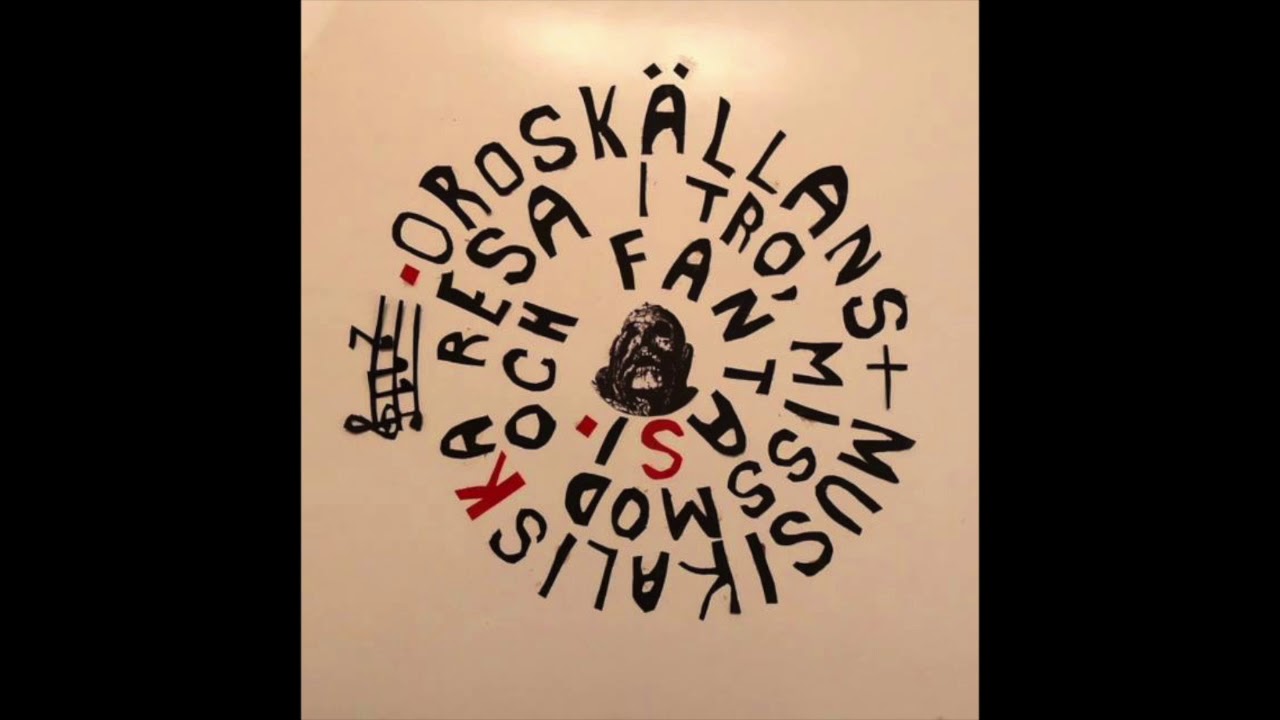
How do you place something like this? It’s probably best not to. This is outsider in the sense that it was made outside. It is also lolloping, naive, somehow lazy and brilliant. This pretty fucking obscure, small project is released on Gothenberg label Förlag För Fri Musik and goddamn, I love it.
When I say lazy, I mean that I bought this from East London record shop Low Company recently and Sanjay had to pritt-stick the sleeve notes on the back as they hadn’t bothered to finish their own artwork before sending it off. I can’t translate the title fully, but it’s something like “Musical journey of concern in faith, discouragement and imagination”. It is two blokes, Dan Johansson (who is in Sewer Election) and Gustaf Dicksson (who is also Blod) but any more detail than that and you’re probably best looking inside someone’s head than online.
It sounds like an out-of-time jam by two drunks beside a river on the industrial outskirts of town, while they tune a car radio into various stations from the city’s diaspora – there’s a bit that sounds like an Indian raga but isn’t, and the uninspired Hallelujah’s of a small protestant-sounding congregation with organ and various chunks of Swedish chat. They try to play something like an old paint can along with modal jams on a recorder but fail to find a rhythm. If this sounds awful, I’ll say you’re wrong after I’ve had a swig of their moonshine – it’s wonderfully open and the collaging is loose but has an intuitive rhythm and a sweetness.
There’s a brilliant genre tag on Discogs called “non-music” which is really intended for comedy records, audiobooks on vinyl, that sort of thing, but I’m all for it being co-opted by projects like this that are having a go at resisting all and anything that might be called music while somehow still making it. Colour me totally charmed.
Noor – Wont To Wanton Eyebath/ Synapse Fusion Refusal
(Ultra Eczema)
On a recent exploration of the various platforms/ distros/ record shops which I roam among, I felt the ghostly touch of a Proustian rush. It was triggered by a little nod and a wink of sound that took me back to a time when I was well into the sort of DIY bedroom production sound that made me feel all funny; music made by dream girls with loop pedals and/or a four track.
What’s made me go all funny this month is this 7” by Lebanese-American artist Nour Mubarak on Dennis Tyfus’ Ultra Eczema label. It has a nearly-cute tune (it’s about “stifled compulsions and the violent/desirous impulses of people and nation states”) and an actually cute drum machine, features a couple of pedals and some really good hooks. It all falls loosely together, before descending into something more chaotic, with edges that are frayed by clipping. I love it.
It takes me back to a time when I bought all of the Grouper records without a second thought. I don’t think this is as disposable as some of the bedroom pop that was being churned out back then, as I wouldn’t have listened to it so many times in a row if it was. Indirectly and accidentally it’s acted as a madeleine for my past and forgotten listening habits, and as such I will henceforth be taking refuge in Not Not Fun, Rangers, Grouper, and bands that played at Yes Way festival without ever releasing anything.
Kali Malone – The Sacrificial Code
(iDeal)
I thought I didn’t need more organs but Kali Malone has become a recent fave. These gusty contraptions sound cranky and tired. The Sacrificial Code is a big room version of her last album Dirges, and in sections this really pulses with morose energy, containing occasional ‘beats’ created by two similar notes played together. Apparently these pieces are all “governed by a strict acoustic and compositional code” but that code isn’t documented publicly anywhere so I can’t tell you what it is or if it would make any difference to your listening experience. This release sits in a solid clan of organ (stop) pushers: see also Ellen Arkbro. (Both Malone and Arkbro are based in Stockholm and have worked together.)
My favourite parts of records like this are always the accidental bits – someone drops something or kicks over a beer bottle, or else a door slams. On Áine O’Dwyer’s organ record the cleaners potter around in the background. In Poul Gernes’ only existing recorded output – 20 minutes on a salvaged harmonium – his child comes into the shed and starts chattering while dad is playing. In all these moments, the room snaps into focus, and sound becomes space. In Malone’s ‘Glory Canon III (live in Hagakyrka)’ here, doors click open (or is it papers falling on marble floors?) and all of a sudden, you are not alone.
Jon Collin – Water & Rock Music Volumes 3–6
(Early Music)
A final entry for a favourite who also brings a space (or a place) to a recording. Jon Collin is one of my favourite living guitar players. He always records somewhere and I always feel like I’m listening in on something private.
My disclaimer here is that after buying a copy of Tony Conrad’s Four Violins from him in an English-themed pub behind Stockholm bus station we have become friends, so this post is not without bias. Before we met, one of his earlier records was the constant soundtrack to the late nights I was spending alone in my kitchen, drinking a lot and eating poorly. This week, after hosting too many concerts in his living room, he’s discounted all his releases in an attempt to make up some of the deposit his landlord is apparently withholding. All his solo Bandcamp stuff is discounted, and the entire discography of Early Music is about £20.
Some Fragmentary Footnotes On Other Occurrences
This sounds like the mangled entrails of something much more pleasant – a blood sausage squeezed rough handed from the meat of Morton Subotnik perhaps. Flaming Pines has released a heavyweight concept album. And as I finished this column Important announced two archival releases of early Oliveros. TIP!