Greetings riff addicts, and welcome to 2019’s busiest month for metal releases so far. Just as I was starting to think that this year was struggling to follow 2018 in terms of new heavy music, the last four weeks have delivered a frankly obscene number of great records. There was far too much to squeeze in to this column, from Sunn O)))’s joyously overwhelming Life Metal (which is covered elsewhere on the site) to Darkthrone’s Old Star, which remains strictly under lock and key until its May 31st release date.
If lead-off track ‘The Hardship Of The Scots’ is anything to go by however, we’re in for another belter. We also got new records from Spirit Adrift, Martyrdöd, Dead To A Dying World, and the JØTNARR album that I raved about in this very column a while back has finally seen a vinyl release, so make sure you pick that one up.
Avant-sludge trio and tQ faves Ghold released a new album out of the blue too, and whilst I’m still digesting it, it’s safe to say it’s yet another sprawling, heady mindfuck, just as you’d expect.
Ulver dropped a live album out of nowhere too, and Entombed‘s live recording of Clandestine finally hits shelves this month as well. Moving slightly further afield from metal but remaining in the realm of inventive, loud guitar-based music, the new releases from Hey Colossus, Big Brave, and Screen Wives are all well worth checking out too.
But anyway, I’ve rambled enough – let’s move on to the stuff I did actually have time to listen to and form a coherent opinion on, shall we?
Saint Vitus – Saint Vitus
(Season Of Mist)
At this point, doom pioneers Saint Vitus really have nothing left to prove. Their 95 reunion album with original vocalist Scott Reagers Die Healing is considered a career highlight, and their Wino fronted 2012 comeback Lillie: F-65 is a modern day classic that sits comfortably alongside iconic records like Born Too Late and V in their back catalogue. Following the group’s various hardships in recent years (Wino’s exit after being detained on drug charges in Norway in 2014 threw a spanner in the works, not to mention original bassist Mark Adams battle with Alzheimer’s in 2016, which the group are still raising funds for), we wouldn’t begrudge guitarist and all-round metal lifer Dave Chandler for taking some well-deserved time off, but Vitus are not only back in action, but back with an album so good that it puts doom bands half their age to shame.
With Reagers back behind the mic and former Down and Crowbar bassist Pat Bruders taking care of the low-end, this self-titled opus (not to be confused with their 84 debut) contains everything that makes this band so vital; namely, powerhouse doom metal anthems, moments of righteous punk energy that hark back to 85’s Hallow’s Victim and some of the darkest, heaviest material they’ve put to tape yet. Songs like the crushing ‘Last Breath’ and forlorn, subtle and haunting ‘A Prelude To…’ feel like the next logical step from Die Healing’s starker, more atmospheric cuts like ‘Sloth’ and ‘In The Asylum’, only taken to an even more harrowing extreme. Meanwhile, raucous, riff-laden tracks like lead single ‘Bloodshed’ and the swinging, irresistibly groovy ‘Hour Glass’ would have felt right at home on their first two records, with Reagers’ soaring vocals sounding as expressive as ever. Closer ‘Useless’ is probably the most explicitly punk Vitus have ever sounded, a minute-and-a-half-long rager in the vein of Circle Jerks or early Black Flag that gives new drummer Henry Vasquez a chance to demonstrate his impressive chops. Saint Vitus is a thrilling reminder not only of the band’s undeniable influence and importance in this genre, but also that old dogs can indeed learn new tricks.
Possessed – Revelations Of Oblivion
(Nuclear Blast)
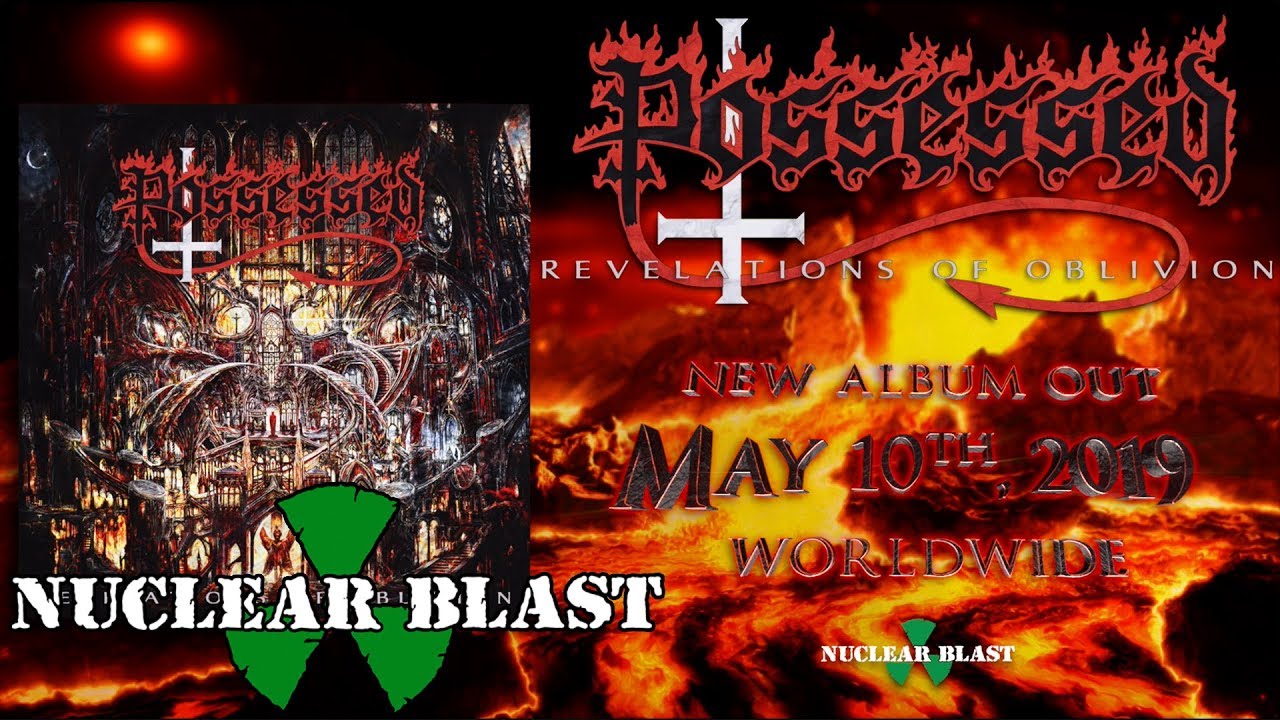
Vitus aren’t the only old dogs returning this month, with death metal pioneers Possessed dishing out their first full-length record in 33 (count ‘em!) years. Making a comeback after such a long time is always risky, especially given the band’s entirely new lineup (with the exception of founding vocalist Jeff Becerra, of course) and the fact that this will inevitably be compared to their debut Seven Churches, an unfuckwithable classic that kick-started the whole genre in the first place. Pleasingly however, Revelations Of Oblivion does an admirable job of recreating that debut’s aggressive proto-death sound and largely leaving behind the straight-up thrash of its polarising 86 follow-up Beyond The Gates. Songs like barnstorming opener ‘No More Room In Hell’ and the raucous ‘Abandoned’ come laden with frantic, tantalisingly evil riffery, poundingly primitive drumming and chaotic divebomb solos, whilst ‘Demon’ darts between taut, blistering power chord assaults and simpler but no less ominous chugging. Becerra sounds good too; whilst his voice is obviously not quite as feral and unsettling as it was back in ’85, he attacks these songs with palpable relish, and it’s still a thrill to hear his hoarse, commanding bark in action.
At almost twice the length of both Possessed’s previous albums, there is a bit of flab on Revelations Of Oblivion, and the nagging sense that whilst it certainly doesn’t stain or detract from their legacy, it doesn’t add a whole lot to it either. Time will tell whether this is just a one-off or the start of a fertile and creative post-reunion career (it can be done, just look at the heights Autopsy have scaled after their decent but similarly overlong comeback record Macabre Eternal, for instance), but if you don’t like overthinking these things and just want a blast of fresh proto-death nostalgia, this will absolutely hit the spot.
Nocturnus AD – Paradox
(Profound Lore)
You wait decades for follow-ups to classic death metal records, and then two show up at once – typical, eh? Yes, Mike Browning has unveiled the new incarnation of Nocturnus and the sequel to the band’s legendary 1990 debut The Key. A founding member of Morbid Angel, drummer/vocalist Browning was ousted from the band before the recording of their iconic Altars Of Madness album, and promptly set about forging his own legacy with sci-fi inspired tech-death pioneers Nocturnus. By the time the group released their second album Thresholds in 92 however, Browning’s writing contributions had been sidelined, with the band bringing in a separate vocalist and flexing their progressive muscle even more, before kicking Browning out of his own band and ensuring the rights to the band name. Whilst Thresholds is still a great record in its own right and better than many give it credit for, it certainly wasn’t the follow-up to The Key that fans were hoping for, and left the band at something of a dead end (the less said about Nocturnus’ Browning-free Ethereal Tomb in ’99 the better, really).
With Paradox, however, Browning has achieved the impossible in delivering a record that not only captures the same atmosphere and feel of that lauded debut, but also builds on it and advances the band’s sound in satisfying and unexpected ways, whilst still remaining true to its roots. Opener ‘Seizing The Throne’ instantly transports the listener back to 1990, with dense, obtuse riffing, sinister keys and lyrics that manage to be self-referential without coming off as cheesy, but then halfway through ‘The Bandar Sign’ the record jets off into a whole new dimension, pushing the speed and intensity levels even further than The Key. Wild, cacophonous synths explode atop one of Browning’s most frantic, speedy drum performances ever, like emergency alarms blaring out of a burning space vessel, and things get progressively weirder from here on in. ‘Precession Of The Equinoxes’ provides all manner of twisting, turning tremolo and ludicrously fast sweep-picked leads, whilst the album’s longest track, the knowingly titled ‘The Return Of The Lost Key’, is a vertigo-inducing display of disorientatingly awkward riffs, cinematic keyboard layers and Browning’s demonic, delay-drenched cackle. ‘Apotheosis’ allows keyboardist Josh Holdren to shine even further, building a cold yet evocatively mechanical intro that feels like waking up from a light-year long slumber in one of Alien’s space pods.
Honestly, there’s not much to criticise here. Browning’s vocals have noticeable wear and tear, occasionally sounding more like D.R.I.’s Kurt Brecht rather than the otherworldly space-faring demon found on The Key, but he still sounds great nonetheless, and his new bandmates do an uncanny job of nailing The Key’s unique atmosphere, which is perhaps not too surprising given that all of them have played alongside Browning in After Death since 1999 (bassist Daniel Tucker is also the same Daniel Tucker that played on Obituary’s classic Slowly We Rot too). Ultimately, Paradox is a perfect sequel to The Key; it ups the intensity whilst also elaborating on the use of keyboards and sinister sci-fi sounds that made that album so unique without retreading old ground, and it serves as both a potent recap of what made Nocturnus so good in the first place whilst simultaneously progressing their style and catapulting it at Mach speed into the 21st century.
Origin – Abiogenesis – A Coming Into Existence
(Agonia)
You needn’t look far to see evidence of Nocturnus’ influence on modern technical death metal, with Origin being a fine case in point. The kings of lightspeed sci-fi brutality are back this month, not with a new album but a collection of re-recorded early demos, the first disc of which predate Origin as we know them today. Known as Necrotomy originally between ’90 and ‘91, before switching to Thee Abomination in ’92 and finally settling on Origin in ’93, these recordings give a fascinating glimpse into the band’s development. Rather than the lo-fi racket you may be envisioning from a demo collection, all of these songs were re-recorded in their entirety by guitarist Paul Ryan, handling all instruments himself. Whilst undeniably impressive, it does seem like a missed opportunity not to include the original demos alongside them (especially as this disc is only 15 minutes long in total), making this more of a reimagining of the past then an actual exhuming.
As for the songs themselves though? Both the former bands retain Origin’s ludicrously fast approach to songwriting, but the Necrotomy material has a bit more of a grindier edge to it, thanks in no small part to the inclusion of more prominent high-pitched shrieking vocals alongside the deep guttural barks. Interestingly, the Thee Abomination stuff throws in some groovier riffs that recall Origin’s more recent Jason Keyser-fronted material more than they do the band’s earlier abrasive wall-of-sound style, found on records like Echoes Of Decimation. The second disc consists of a remastered version of Origin’s debut EP A Coming Into Existence in its entirety, and will sound instantly recognisable as the same band to fans even if the material itself is unfamiliar. It’s great, if you were wondering, not quite as fully realised as their later full-lengths but still a staggering collision between Nocturnus’ space faring grandeur, the intense brutality of Suffocation and the band’s own fanatical devotion to pushing their instrumental prowess as far as it will go.
Abiogenesis is completely inessential, but is nevertheless an interesting snapshot of one of technical death metal’s most terrifyingly precise outfits in embryonic form.
Employed To Serve – Eternal Forward Motion
(Universal Music Operations/Spinefarm)
It’s been immensely satisfying to watch Employed To Serve’s growth from obscure bedroom grind project to bona fide Kerrang! cover stars and one of the most ferocious and important post-hardcore acts on the planet right now. 2017’s The Warmth Of A Dying Sun set a high benchmark, coalescing the white-knuckle intensity of the group’s live show into an extremely powerful and cohesive album experience, so hopes were high for this follow-up and it doesn’t disappoint in the slightest. The sense of righteous anger emanating off this thing is undeniable, with songs like the title track and ‘Beneath It All’ opening the album like a swift boot to the cranium. The riffs are consistently interesting and engaging too, managing to combine intricate, precise dissonance with confrontational, adrenaline-pumping immediacy. Even the breakdowns here manage to avoid cliché and sound genuinely threatening in a way most macho modern hardcore bands simply can’t; the oppressive, evil dirge that closes ‘Dull Ache Behind My Eyes’, for example, is more in line with vicious, seething noise rock than knuckle-dragging beatdown, and builds to a claustrophobic, affecting climax rather than just hurling its weight around.
As the name suggests, Eternal Forward Motion doesn’t allow itself to sit still or stagnate for a second, remaining exhilarating and sharply focussed for its full 41 minute duration. All these songs feel distinct and dynamic, with tracks like ‘Force Fed’ experimenting with choruses outside traditional song structures, and ‘Reality Filter’ veering between tight hardcore chug and chaotic, free-form noise like an out-of-control truck drifting violently between lanes. Dream-like closer ‘Bare Bones On A Blue Sky’ is perhaps the biggest surprise, an effective blend of forlorn shoegaze textures with cathartic post-hardcore bluster, like Kevin Shields fronting Converge. Great stuff, and another seemingly effortless demonstration of just how far ahead of the pack Employed To Serve are.
Gaahls WYRD – GastiR – Ghosts Invited
(Season Of Mist)
Everyone’s favourite wine sippin’, Satan worshippin’ black metal caricature returns this month too, with the long awaited debut from his Gaahls WYRD project. Following the messy legal battles over the Gorgoroth name, Gaahl and bassist King Ov Hell’s God Seed project showed real promise with their 2012 debut I Begin, pushing beyond the straight-up black metal of Gorgoroth into weirder and more abstract pastures. After God Seed dissolved in 2015, Gaahl seems to have ventured even further down that path with this new record, that runs the gamut from traditional swarm-of-angry-bees Norwegian black metal (‘The Speech And The Self’), discordant blasting with baritone, almost neo-folk-esque clean vocals (‘Ghosts Invited’), frantic thrash (‘From The Spear’), gloomy post-punk dirge (‘Carving The Voices’) and even a hint of bombastic, foot-on-the-monitor NWOBHM in the unexpectedly anthemic ‘Veiztu Hve’, a song that morphs from cold, blast-addled tremolo into an upbeat retro metal stomp, complete with a booming, catchy chorus.
Tonally, GastiR is all over the place, but is just about cohesive enough to feel like an album rather than a collection of off cuts or Gorgoroth B-sides. Given the infamy Gaahl has gained due to snappy soundbites and Vice documentaries, he could have quite easily just rehashed former glories and churned out uninspired black metal to rapturous acclaim, but it’s good to see him coming into his own as an artist and experimenting with new sounds and atmospheres. Whilst feeling like a continuation of God Seed’s sound to some extent, Gaahls WYRD is very much its own beast and arguably the most diverse collection of songs Gaahl has ever put his name to.
Full Of Hell – Weeping Choir
(Relapse)
Full Of Hell’s previous full-length, 2017’s Trumpeting Ecstasy, seemed to divide opinion. I was in the camp that emphatically and unashamedly loved it, feeling like it was a direct, visceral and no-nonsense distillation of the group’s grindcore sound after the more experimental, noisier string of collaborations that had preceded it, but many seemed to think the quartet were playing it a bit safe. All of which did have me a bit worried when sitting down with new opus Weeping Choirs for the first time, I must admit. It’s not that there’s anything wrong with the ferocious blasting of ‘Burning Myrrh’ or moshpit-ready grooves of ‘Thundering Hammers’, but these first couple of tracks did seem a bit predictable – as ‘Full Of Hell by numbers’ as the band have ever gotten in other words – and I started to wonder if that wild, spontaneous quality of their early work was going to be reserved for collabs and non-album tracks only at this point.
I needn’t have worried though, as immediately after the somewhat obligatory noise interlude ‘Rainbow Coil’, the shit not only hits the fan but connects with enough impact to blow it way off into the stratosphere. The latter half of this album is fucking thrilling, to put it bluntly, offering some of Full Of Hell’s most vicious and most “out-there” material yet. There’s a fantastic moment in ‘Downward’ where Charles Bronson vocalist Mark McCoy fights to be heard over a bleating, cacophonous wall of sound that has to be heard to be believed, and Lingua Ignota lends some absolutely beautiful vocal harmonies and droning, Sunn O))) style textures to the stunning ‘Armory Of Obsidian Glass’. ‘Silmaril’ darts between dizzyingly technical riffs and gleefully primitive caveman battery on a dime, whilst ‘Ygramul The Many’ uses the same repetitive, brain drilling effect as Brutal Truth’s ‘Prey’, before supplementing it with some seriously Scott Hull-esque riffery and then descending into a skronked out free jazz void and back again, all within a minute and a half.
Indeed, the whole album feels a lot longer than it actually is, due to the sheer amount of ground it covers in just 24 minutes, fitting in more ideas than many bands manage over the course of whole discographies. It’s an extremely cohesive, gratifying listening experience and sonic journey too, and further proof that Full Of Hell are one of the most exciting, innovative and unpredictable grind bands around.
Esoctrilihum – The Telluric Ashes Of The Ö Vrth Immemorial Gods
(I, Voidhanger)
French one-man outfit Esoctrilihum’s latest also feels a lot longer than it actually is, and given that it runs at a hefty 75 minutes, that’s no mean feat. This isn’t a criticism however, as the cumbersomely named The Telluric Ashes Of The Ö Vrth Immemorial Gods contains enough interesting ideas to keep you transfixed throughout, but the aggressive manner it bludgeons you with them and the sprawling, nightmarish way they’re presented is absolutely exhausting, in the best possible way. Existing in the same realm of esoteric part-black metal, part-death metal and part-unknowable cosmic horror as bands like The Ruins Of Beverast, Howls Of Ebb and Tchornobog, this is Esoctrilihum’s fourth hour-plus full-length in the space of just two years, and arguably the most successful. There’s ever so slightly less emphasis on atmosphere this time round, and more of a focus on absolutely fucking massive riffs.
That’s not to say this album isn’t atmospheric, because it certainly is, but rather than conjuring it via lengthy ambience or spooky synth segues, we get disorientating, head-spinning guitar tapestries (check out single ‘Kros Ö Vrth’) and sickeningly heavy, almost physically oppressive moments like that bit in ‘Invisible Manifestation Of Delirium God’ (a title that could sum up the project’s raison d’etre quite nicely) where ominous tremolo picking, bewilderingly swift double kick rolls, eerie leads and coarse, reverb smothered bellows all come together to create a feeling akin to a fever dream. ‘Stone Of Static Void’ utilises a hammered dulcimer to fantastically eerie effect, propped up by frantic blastbeats and a gnarly Mitochondrion-esque riff. There’s frequent and effective use of melody in amongst the horror here, but even then it has a spectacularly sinister feel to it – ‘Inexorable Plague Of Time’, for instance, has a triumphant but strangely uncomfortable quality to it, like hearing At The Gates’ ‘Slaughter Of The Soul’ at the wrong speed whilst on heavy dissociatives.
The Telluric Ashes… won’t be for everyone, but those who choose to brave its mystifying, labyrinthine morass in its entirety are in for a treat.
Inter Arma – Sulphur English
(Relapse)
If any band has become synonymous with mystifying, labyrinthine morasses in recent years though, it’s Richmond’s post-prog-black-death-sludge-whatever outfit Inter Arma. The band’s sound is a unique one, throwing elements of progressive rock, southern stoner metal, vintage Morbid Angel, latter day Neurosis, crust punk and black metal into an unwieldy melting pot, lighting a set of fireworks beneath and standing back to bask in the explosive results. On paper, it may sound fairly muddled, but previous releases like 2013’s Sky Burial and 2016’s Paradise Gallows managed to tie it all into a cohesive whole, albeit a whole that was frequently impenetrable. Both those albums are great, but often felt like the band were in danger of losing themselves amidst the vast, colourful sprawl they’d created.
Fourth full-length Sulphur English, however, is a much more streamlined and focused affair. Whilst still over an hour in length, the album’s peaks and troughs feel more carefully coordinated and it all flows in a very organic, natural manner. Songs like ‘A Waxen Sea’ and ‘Citadel’ open the record on a powerful note, warping bristling Azagthoth-ian riffs around spiralling tribal drum workouts, before the beautiful ‘Stillness’ allows some breathing room. It’s a slow burner for sure, but also builds to one of the most satisfying, devastating pay-offs in the band’s discography. The same can be said for the three towering epics that close the record too (the churning, relentless ‘The Atavist’s Meridian’; ‘Blood On The Lupines’, a stark, haunting track with emotive leads, like David Gilmour stranded in Twin Peaks; and the vast, tantric death metal of the title track), and indeed, the album as a whole. The pacing is fantastic here, drawing out certain hypnotic passages for maximum impact before climax without allowing them to lose momentum, drift into stagnation or buckle under their own weight. Every minute here feels crucial.
Inter Arma is a band I’ve admired for a while now, despite feeling like their first truly incredible record hadn’t quite fully formed yet. This, however, is that record, and it’s absolutely fucking stellar.
Krypts – Cadaver Circulation
(Dark Descent)
Over the course of two albums, a demo and an EP, Finnish Krypts have become one of the most cherished contemporary purveyors of lumbering death-doom. Third album Cadaver Circulation tips that scale heavily towards the ‘doom’ rather than the ‘death’ end, resulting in their most desolate release yet, made abundantly clear as opener ‘Sinking Transient Waters’ gradually collapses into a thick, murky audio swamp as the cavernous guitars eclipse the minimal, surprisingly subtle drumming in its latter half. ‘Vanishing’ approaches funeral doom territory with its majestic, snail-paced misery, and even comparatively more up-beat numbers like the three-minute ‘Mycelium’ are wrapped in a dense smog, never dwelling on blastbeats for too long before dropping back into slow, tar-like waves of filth.
The band have been getting progressively doomier of course, with 2016’s Remnants Of Expansion experimenting with much slower passages and stretching the band’s filthy sound to breaking point, but even with that considered Cadaver Circulation is still an incredibly oppressive listen. Those looking for old school death metal kicks may be disappointed, but doom heads and those interested in the weird cracks and crevices that are unearthed once extreme metal drops beneath certain tempos will find much to revel in here.
Blind Monarch – What Is Imposed Must Be Endured
(Black Bow)
Finally, here’s one I’ve been waiting for with bated breath for some time. Sheffield quartet Blind Monarch’s live shows have earned them reputation as one of the most consistently crushing new doom acts around, hitting that sweet spot between Burning Witch’s barren riffscapes and Graves At Sea’s seismic groove whilst adding a distinctly despondent flavour all of their own. This debut album captures the band in fine form, with opener ‘Suffering Breathes My Name’ building from sparse, patient rumbles to ear-splitting tides of distortion à la Corrupted. Vocalist Tom Blyth alternates between titanic guttural bellows and a tortured high-register shriek that’ll send shivers down your spine, as the band shift between sloth-paced dirge and ever-so-slightly more up-tempo sludgy sections that recall Noothgrush or Grief, especially on the track ‘Blind Monarch’ (because every decent doom band needs to have a titular song, it’s the law). Guitarist Adam Blyth manages to incorporate a soaring, otherworldly lead here too without sacrificing any of the song’s morbid atmosphere, kept afloat by drummer Lee Knights’ ponderous but commanding beats and bassist Paul Hubbard’s gut-rumbling bass tone. ‘My Mother, My Cradle, My Tomb’ ventures into more mystical death-doom territory, even hinting at black metal with the cold, dissonant passage towards the end, and closer ‘Living Altar’ is arrestingly sombre, with very subtle atmospheric flourishes and distant chanting conjuring a vibe somewhere between Bell Witch and Cathedral’s Forest Of Equilibrium. This is easily one of 2019’s most gratifyingly punishing doom releases, and essential listening if you like your metal slow, low and evil.