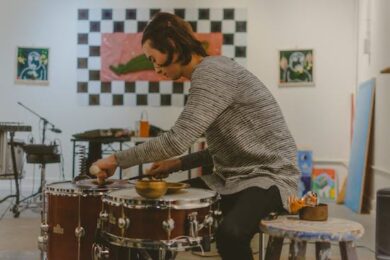


A large chunk of a recent episode of Spool’s Out radio featured a live set by Nottingham-based artist Bredbeddle (aka Rebecca Lee), made last year at Primary. Musician/ composer/ artist Rebecca Lee makes has made music using variety of systematic methods in the past, but Bredbeddle focuses on collages made by "organising ideas from different musical situations/scenes". This recording represents the first live appearance of the project. The episode also featured new music from Portuguese duo HRNS, Zu bassist Massimo Pupillo, and new Berlin noise from Dis Fig.
Head over to spools-out.com, or the Resonance FM website to find out more about the show. This episode and others can still be streamed in full above, as well as downloaded as a podcast.
The crossroads of British rural fetishism, electronic music, and folksy mysticism have long produced sidelong epics. Look no further than Hergest Ridge or the second side of Gong’s You. English duo Teleplasmiste – credited here as “hailing from the Glastonbury and Avebury Leylines” – fit right into this tradition, utilizing synths, samples, bagpipes, winds, and bells to craft two 20-minute-plus headtrips. This connection to a synth/rural exploration of mystical musical places is perhaps unsurprising considering the duo comprises Michael J York (has played bagpipes and such with both Coil and Shirley Collins) and Mark O Pilkington (who runs Strange Attractor Press).
‘Science’ blasts off with a snippet of British 60s icon and organist Graham Bond yelping the title of his track ‘Love Is The Law’, split in two and phasing in a direct tribute to the phasing processes used by Steve Reich (think ‘It’s Gonna Rain’). Beneath his voice, Bond’s organ overlaps on itself, turning into a shimmering drone, which Teleplasmiste mimic with a slowly crawling synth drone, gradually building and taking over the duelling Bonds. It’s a simple and well-established trick, but it nonetheless most certainly still works. The 24-minute track’s a hell of a trip, never outstaying its welcome, and Graham Bond’s insistence that “Love Is The Law” seemingly mutates in intention from celebratory to passionate to angered insistence to madness.
The flipside, ‘Religion’, heads out even deeper into the cosmos with the pair serving up organic pipe drones and synth buzz in a variety of shapes and sizes later switching to arpeggiated key bleeps and flute, again mutating into a looped sample snippet and stretched and skewed electronic pulses. The thematic aspects of Teleplasmiste, this belief in a kind of mystical British rural underbelly, in a connecting force, in a scientific religion, I still have to suspend my disbelief to get on board with it with every listen. Yet there are times where, like on a ley line, things can arrive at just the right place.
Hailing from Portland, Oregon, vocalist Noa Ver and drummer Zach D’Agostino both shove their instruments through rough and tumble DIY electronics as Sea Moss. So while Noa’s screeching and Zach’s pummelling, the mix is also full of warm cuddly old school noise detritus; bleeps and screeches and whirrs moving in sync with the band. We’re a decade-and-a-half past the golden age of American noise-punk (think Lightning Bolt and Black Dice) but this still feels fresh. They recorded the whole thing live to tape at a gallery in Portland (is it possible to be any more Portland that that might I add), so the energy is furiously high throughout.
The actual ‘songwriting’ is damn on point too. The pair sync up in a way that’s constantly energised and exciting, and the brief tunes actually often link up to form seamless little suites – opener ‘Bidet Dreaming’ ends with pounding drum sticks that slip right on over into ‘Better With Wine’ for example. It’s always been the way with this kind of red raw DIY noise punk, especially when minimised down to just a duo. If you can underpin the homemade noise with hooky tunes and grooves, you’re onto something the impact of which is far longer lasting (obviously). ‘Appease The Peas, Please’ (yeah the titles are good) opens with a post-techno wonky electronic tune bashed out via noise-filtered drum stick hits. As Noa’s singing comes in, you realise it’s just an outright banger… and barely even a weirdo experimental noise track. Who wouldn’t enjoy this? Well, your parents perhaps, but what do they know? As the cowbell-and-static buzzing groove of ‘Feral Fowl’ appears over the horizon at the tail end of the album, you’ll be most likely beaming. It’s incredibly easy to flip the tape right over and start again, even if your ears are starting to ring.
There are percussionists and there are percussionists, and on this utterly weird yet utterly heartwarming tape by American improviser Claire Rousay, one wonders if the label even fits any more. The way she fiddles with and scratches and fumbles and toys with these drums and objects, utilises them in a way that sounds almost more domestic than musical. Rousay doesn’t trace rhythms or even build musical moments, but rather acts out a scene. It’s an audio soundscape of inanimate objects vying for human attention, with Rousay blessing some of them long enough to bring them to life. You can picture a young child playing with their toys for the first time, only just realising that they can even make sound at all.
After seven quiet minutes of slow exploration, opener ‘Clocked’ ends with what sounds like some vaguely more typical brushwork and bell noises. But only just. This albums sits at the borderline between solo drum record and ASMR video, which is to say there’s some blinding (if somewhat indescribable) percussive work happening, but the overall effect is one that calms the mind and pleasantly busies the senses. Rousay is utterly patient about deciding when to approach her drums in any typical manner, and it makes those moments of sparse tom and bell hits (the end of ‘For Jacob’ or ‘Shadow’) unexpectedly powerful. This is a unique percussion album – quiet, patient, abstract, warped – and at times feels like it barely exists at all. Rousay is speaking an alien drum language all her own here, but listen hard enough and you’ll start to pick it up.
Ahh, these two tapes by Co-Habitant and the symbolically named [. . (]. feel like a beautifully executed throwback to the blogspot days of underground tape exchanges. Little-to-no solid information seems available online, but that’s part of the experience. It makes these bleak, black, almost cacographic cassettes seem as if they were manifested into existence by an unseeable force. Ambient detritus from the Black Lodge perhaps? Either way, the effect reminds me of the days before Bandcamp ruled the scene, when one would wire some money to an email address posted on a blog page beneath a picture of a tape with an artist name and little else to go by, and weeks later it would arrive in the post a complete surprise. It perhaps gives the music something of an unfair ‘advantage’ in the form of a contrived sort of mystique… but who cares? The effect is cool as shit.
The tape credited to Co-Habitant comprises soft and floating synth melodies, barely changing arpeggios that lilt and levitate slowly for eight minutes at a stretch (check out side A track 3), or unshaking descending chime tones resembling a maddening looped lullaby for Damien from The Omen (side B track 2). There’s very little to it really, but the patience, sheer blackness, and minimalism are massively effective.
The sister tape credited to an artist denoted simply with brackets and dots – [. . (]. – could most likely be the same anonymous artist, but the difference in mood is worthy of the name change. The formulation is similar, with the music on ten unnamed tracks often barely shifting from a single melodic line or repetitive musical idea on a synth. More effects are utilised however, with delay unfurling notes into bouncy echo chambers, or the artist even slowly lifting a filter over eight minutes (as on ‘unnamed_003’), making an arpeggio loop into an epic journey. The keyboard stabs are more pointillistic here (‘unnamed_008’), making this project somehow the more menacing evil twin to the Co-Habitant release above. If Co-Habitant is built around a kind of peaceful dread, then the music of [. . (]. is a dreaded kind of peace. Anonymity is perhaps a mask, but then again, it gets one listening more deeply to the music, and lets the sound speak for itself.
Merry Peers is a pair of Berlin residents crafting sumptuous soundscapes and dreamworlds in a manner that is far less clichéd than either of those nouns make the effort sound. Brad Henkel plays his trumpet through a bunch of effects and Yoshiko Klein mans the synthesizer bank, guiding this ship from the bridge right into outer space. Henkel spends the first few minutes of side A’s single piece ‘Glad We Did’ talking us through some softly spoken self-help over a blissful synth bed: “I guess all we can do is breathe/ take a second/ close your eyes/ and breathe/ give yourself a few seconds to let go/ close your eyes/ don’t look away/don’t look away.” The veracity of the sentiment is perhaps questionable, as there’s an unsettling sort of inversion to this ambient dreamworld Merry Peers create. It’s almost like Henkel’s opening words are designed to lower our defences before grabbing our hand and marching us slowly into a dream that’s more Dali- than Eno-esque; a desert of synthesized winds punctuated by stoney warped trumpet lines.
The flipside is equally strange and engaging, with Henkel and Klein continuing to guide us into a strange place of their imagining. Henkel’s trumpet is too subtle and textural to resemble Jon Hassell’s (the most obvious comparison I know, sorry) too closely, and on side B’s ‘You Say Me’ weaves seamlessly into a hissy bed of Klein-like synth drones around the halfway mark. The pair meld truly into one for a while in a compelling and sensual moment, and then the piece rambles onward towards a lush finale of healing tones and warm washes of processed trumpet and synth melodies. This is most certainly dream music, but quite what the Latenter Trauminhalt – the ‘latent content’ as Freud would describe – actually is remains tough to extract. It’s a beautiful experience, but quite where it takes you is refreshingly hard to pin down.
Prague-based Izanasz (real name Jan Palatý) often works as an audiovisual artist, utilising runes and characters of his own creation in live projections. I only mention his neography (shown off on the album’s artwork) as the creation of a unique alphabet analogises well his musical methods. Izanasz comes deep from within the same massive ballpark that Autechre, Xenakis, and Samuel Beckett all inhabit, where recognisable totems get us through the doorway, only to plonk us down on the other side in a room full of strangers and unidentifiable emblems.
The second in a series of three releases, Psykedelar Vol. 2 is part of an “attempt to capture what psychedelic experiences feel like to me”, explains Palatý. In that sense, it’s definitely a fully successful undertaking. Deep into the slow, monstrous, creaking, dozen-minute epic of ‘Alveg af fjöllum’ (Icelandic for ‘All Of The Mountains’), it’s impossible to feel normal. The tempo of a buried pixelated lattice of digital tones speeds up, and a generated gang of degenerate tones refuse to make sense. The music is occasionally danceable I guess (if you’re a weirdo, you can dance to anything right?) but the music’s relationship with club music is perhaps more circumstantial than anything else, a quirk of using similar gear (DAWs and modulars I’m guessing). This might well be a brain-frying trip into stretched and skewed music, but it’s not without its outright pleasant moments either. ‘Krypp’ digitally stretches out what sounds like a guitar lick from sub-Saharan Africa, and sits it atop a pretty standard IDM groove and plays out just like you instinctively want it to. The tape as a whole though, is a notably weird trip – to the extent that I’m not even sure I could recommend mixing actual psychedelics with Psykedelar.