
Sometimes the way some people compare Billy Woods to this or that dead novelist can grate on the nerves, carrying as it does a whiff of the bad old days of high society rags like The New Yorker needing to assure its readers that hip hop was, like, street poetry. Because if Cam’ron wasn’t essentially a differently-bescarfed Jorie Graham, what the hell was he doing in those august pages? Or the in-between days, when the intelligentsia (white division) was sussed enough to see Saul Bellow’s rhetorical question, “who is the Tolstoy of the Zulus?” as elitist, if not explicitly racist, while maybe not entirely disagreeing. Bad New Yorker! Bad Saul Bellow! Bad us, for needing the Billy Woods of the Billy Woodses to be Dostoyevsky!
Of course, Billy Woods, ideologue of orneriness, doesn’t make it easy for the pick-me critic who might raise this point and wait patiently for their head-pat. Woods, who has famously rapped about not wanting to see Nas at Carnegie Hall (but isn’t averse to making the occasional feature at Lincoln Center), complexifies like it’s not so much his job as it’s a tic. Naming Today, I Wrote Nothing (his fifth studio album, which receives its 10th anniversary reissue today) after a book by a Russian absurdist who affected a variety of tics to annoy Stalin, thought a good poem should be capable of breaking (literal) glass, and who dressed like a Jim Jarmusch character is one thing. The rapper promoting Today, I Wrote Nothing by citing not only Blood Meridian but the Harold Bloom essay on the novel, while peppering his lyrics with allusions to Flannery O’Connor, is another.
There’s also Woods throwing a one-minute, 34-second-long meta-fiction about a rapper writing about a rapper writing about a rapper – with only the author and the Bobby Shmurda proxy of the tertiary rapper left standing at the 1.33 mark – into the mix. All these discursive layers might be confused for frippery – or, as the introduction to Daniil Kharms’ Today, I Wrote Nothing says: “The major tools of Kharms’s short prose works are digression and interruption; with these he attempts to save literature from its enslavement to progress” – if all these allusions weren’t delivered in Woods’ totalitarian cadence. Finally, Woods calling said track ‘Zulu Tolstoy’ after its making, as a joke for mainly himself and possibly no one else, is enough to make one scan one’s library, looking to see who else Woods can be compared to.
And what do you know, there’s the Saul Bellow section, dusty and unread as an act of allyship, with The Adventures Of Augie March practically busting out from the bookshelf. Billy Woods’ DIY label, Backwoodz Studioz, might already have its singular Chicago existentialist in Skech185 but that doesn’t mean Woods isn’t just as much a Bellows type. The type who writes, as Bellow did in Augie March: “I go at things as I have taught myself, free-style, and will make the record in my own way.” Bellow’s use of “record” is, for our purposes, a very happy coincidence, but there’s no denying that the phrase “first to knock, first admitted” which ends that quotation would sound even better coming out of Woods’ mouth than it does on the page. As Billy Woods is American born to Zimbabwean and Jamaican parents, the claim to Tolstoy of the Zulus can be granted to Mazisi Kunene (at least insofar that he and Tolstoy both wrote 400-plus-page books that I haven’t read – not to imply that anyone should actually give a shit about Saul Bellow’s arbitrary metrics). The point is that, while the comparisons might be diminishing to hip hop as a form, let’s not entirely disregard hip hop’s love of list-making just because, in this particular case, it might be vaguely offensive. Basically, what I’m saying is that, regardless of who gets the top prize for Best Dead Russian (non-dead Russian division), no list of contenders is complete if Billy Woods isn’t on it, and close to the top at that.
In this appreciation of Today, I Wrote Nothing, Woods’ fifth studio album (and either his first, second, or third sleeper masterpiece), the reader will forgive any dancing around the subject. Partially this is as tribute – to both Kharms and Woods’ multiplicities of digressions, inversions, and long stories cut short, as if by forces outside the writers’ control – that’s hopefully fitting for an album that begins not with Woods rapping but his eternal partner ELUCID slashing through the layered swells of a Messiah Musik dreamhouse beat. Also, I got eye surgery the day this was commissioned so I’m using my other senses.
So much of the discourse of ‘hip hop at 50’ in 2023 was devoted to the uncharted territory of rappers ageing past the point of your average Travelling Wilbury. In the case of Billy Woods, this is a funny framing as A, the man didn’t start to thrive until his thirties (with 2012’s History Will Absolve Me), and B, it’s difficult to imagine that there was ever a time when Woods wasn’t in his thirties. He raps about his childhood plenty, from Zimbabwe days of watching the eclipse to his father’s body lying at rest in his home, but I dunno, there were a lot of kids running around the DC metro area in the 90s with blurred out faces. We just have to take his word for it that he was one of them, that he hasn’t been pushing a world-wry forty since birth.
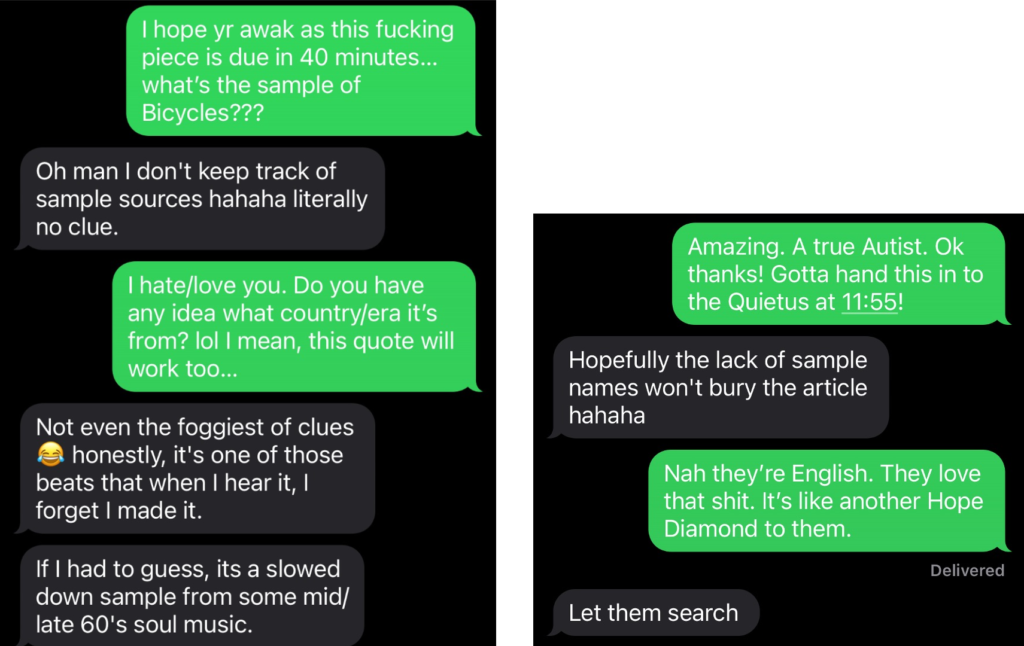
Amusing as the idea of Billy Woods at either end of a portrait of Dorian Gray may be, there’s a danger in typecasting. To do so is disrespectful to a catalogue devoted to seeing people and situations as almost absurdly complicated. It’s also inaccurate, and in a way that should be distrusted for its ease alone. The rapper is known for his dark vision, sure. To the point where critics sometimes get caught up in that narrative; ascribing their own dark glasses to a man of perfect clarity, who likes to live, laugh, and love as much as any other artist (but who also just happens to keep looking, even after the good times sour). For instance, the rude boy folk punk of a track like ‘Bicycles’, with Henry Canyons rapping out of the past like an interdimensional carnival barker, over one of the jauntiest beats in the history of Blockhead (which encompasses so much that, when I asked what the samples were, Blockhead texted back “not even the foggiest of clues 😂 ”) doesn’t come from an artist without some degree of party rocking in their soul. Also, you don’t forge a near-lifetime collaboration with an artist like Willie Green if you’re incapable of groking at least a touch of the universe’s potential for grace (with the way he buoys the line “Bed-Stuy Do or Die, not just a rap line, it’s policy” into a tag-line virtue, Woodhull Hospital should consider hiring Green to produce its ER in-store music). Same goes for ending a song, as Woods does on ‘True Stories’ with a sample of Flannery O’Connor reading ‘A Good Man Is Hard To Find’.
So what if ‘Bicycles’ also contains Woods dropping casual brutality like “Put tape on the tape, dubbed over it twice / Second childhood, neither was very nice / Took it as a joke, but took note he never said sike / Funny, the things you remember your whole life”? So what if the majority of the party-rock crew-choruses on the record could just as easily work as threatening notes passed to a DJ at 4AM? So what if Daniil Kharms spent years doing Monty Python-esque funny walks about town, only to starve to death during the siege of Leningrad? Stalingrad happens. By Woods’ own admission, Today, I Wrote Nothing is about death like a motherfucker, but that’s just for starters. As any dead Russian – actually Russian or not, absurdist or nah – will tell you, there are ways of living that death can only improve on. So, you work with that. Or, as Woods says, “born yesterday, but we stayed up all night”.
The 10th anniversary reissure of Today, I Wrote Nothing, is out now via Backwoodz Studioz