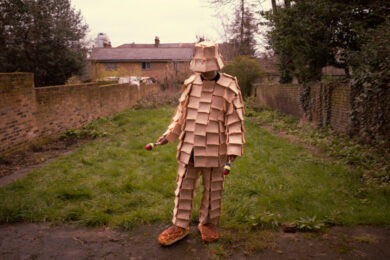

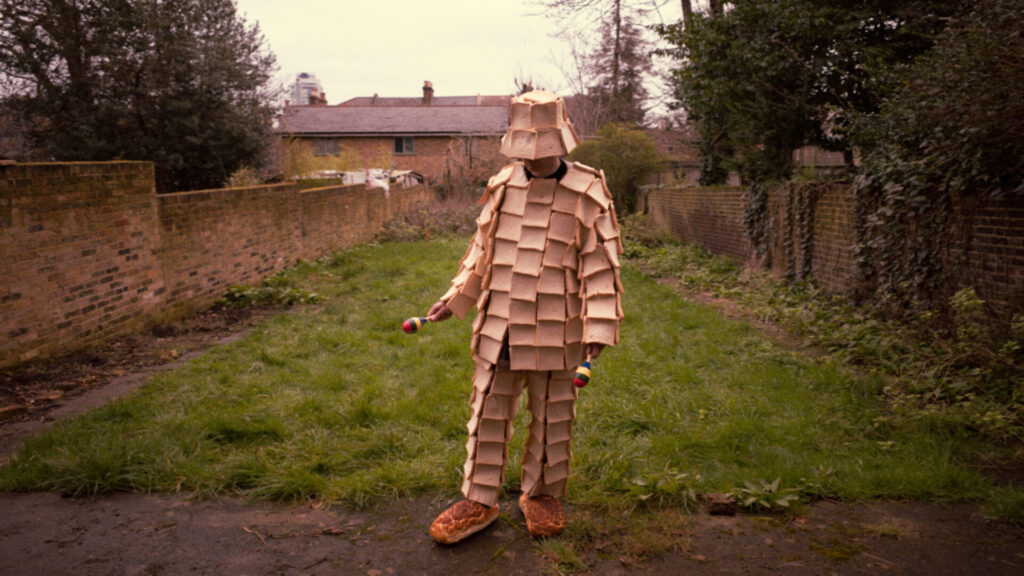
It’s both May Day and launch night for Goblin Band’s debut EP, and the mood inside London’s MOTH Club is febrile. The set is chaotic, joyful and at times surreal – for ‘Turmut Hoer’, drummer Paul Gardner dons an enormous fly costume and launches papier mâché turnips into the crowd. The song ‘The Prickle Holly Bush’ features a condemned protagonist who is saved by their lover rather than a family who are happy to see them hanged. Goblin Band, and many of the crowd, are queer, and as they explained to me in an interview earlier this year, it’s not hard to find LGBTQ+ undertones in this story of salvation through one’s chosen family. When, in the song’s narrative, the lover arrives to the rescue, the roar among the audience evokes a genuine ecstasy.
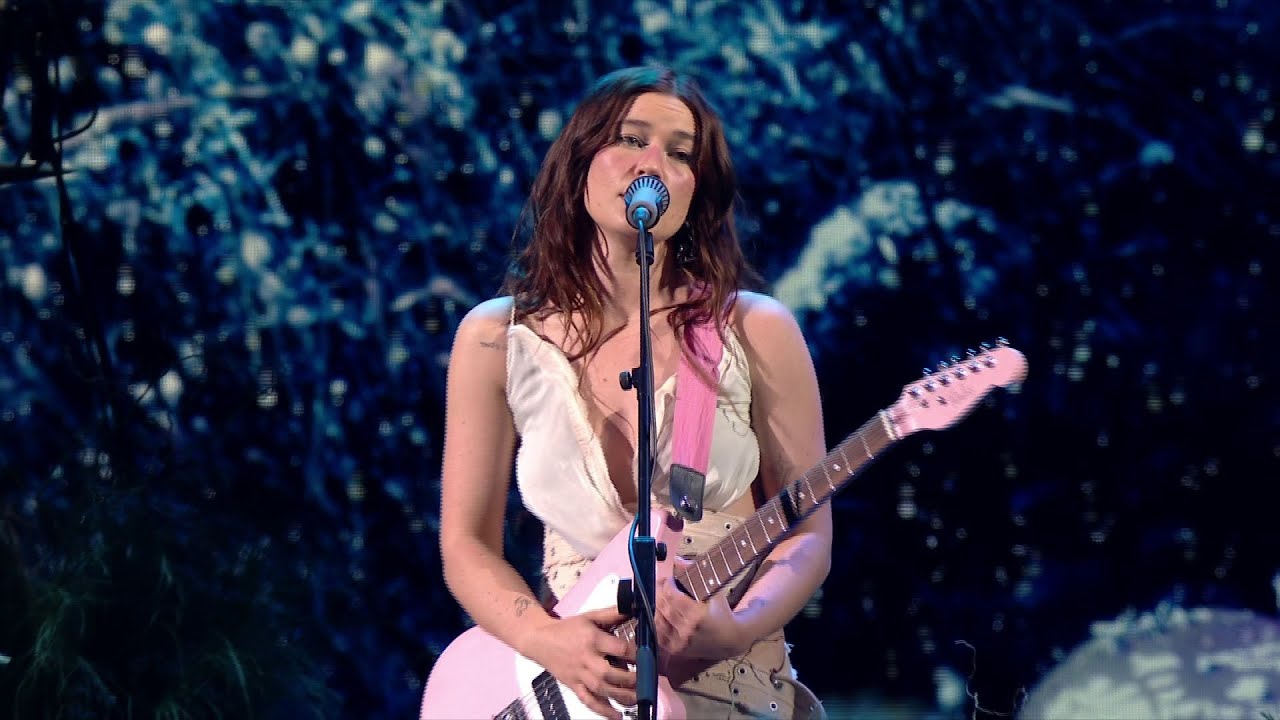
A few weeks later, I’m across the road at the Hackney Empire, once a Victorian music hall, to see Lankum perform their much-acclaimed fourth album in full. Their intensity boosted by their embrace of drone, electronics and experimental techniques, their playing laces the room with darkness and light, and concludes with a glorious, abstract noise barrage, during which the venue’s antique chandeliers are made to flicker as if lighting a séance. At a café in Camden on a Saturday afternoon a few weeks later again, I watch Jacken Elswyth launch her new LP At Fargrounds. It’s an altogether more relaxed affair than the other shows, the crowd filled with families and groups of friends, but no less moving as Elswyth rethinks the capabilities of her banjo.
Taking place within the space of a month, all three of these shows possess completely different energy. Goblin Band are joyful and chaotic, Lankum darkly majestic, and Elswyth gently transfixing. And yet in every case they each prove the same point – that though many of these songs are centuries old, they still reverberate with the deepest emotional power.
In this new quarterly column, I’m going to be getting to the heart of this resurgence in traditional and folk music, focussing particularly on those practitioners who possess a progressive energy, whether in sound or philosophy. I call it a resurgence, rather than a ‘revival’, for a reason. Just because more mainstream attention is increasingly being drawn to those performing traditional music, does not mean that they have ever been absent.
That said, I can’t help but wonder why so many exciting voices are coming to prominence at this particular point. To narrow our focus on the London scene for a moment, one could potentially draw a line between the country’s lurch toward xenophobic right-wing populism, and the stance of many of the scene’s outliers who, by drawing on traditional music through a progressive lens, invite us to engage with national identity and tradition in a way that opposes the bigoted, exclusionary implications of nationalist politics.
Shovel Dance Collective, for example, the nine-strong, vocally anti-fascist group who (to grossly oversimplify) platform traditional songs that contain queer, working class, anti-colonial and socialist themes, performed their first proper show just a few nights after Boris Johnson’s ‘Get Brexit Done’ Conservatives were elected in a landslide victory over the Corbyn-led Labour Party for whom many of Shovel Dance had actively campaigned.
For what it’s worth, Shovel Dance insist, when I meet a few of them for a drink in South London, the connection between their formation and Brexit was subconscious at best, if not a total coincidence. “There wasn’t a grander narrative that made us become a band at that time,” says cellist, guitarist and cittern player Daniel Evans. And yet, acknowledges bandmate Nick Granata, “it was spurred on by the fact that our first gig was emotionally charged. There was a driving force that aided a narrative for us going forward.”
From Shovel Dance’s focus on drawing out hidden narratives, to Angeline Morrison’s essential 2022 project The Sorrow Songs, where she wrote new folk songs to acknowledge the presence of the Black people who have existed in Britain since at least the Roman era, to the likes of Goblin Band and a number of others finding the queerness in centuries-old songs, the cliché of folk music as the realm solely of white, straight, bearded, acoustic-guitar wielding cisgender men, is being challenged to an extent it never has before. It is not so much about ‘introducing’ new voices, however, it’s worth stressing, but about amplifying and acknowledging those that have always been a part of folk music’s fabric.
As the musician Ray Aggs tells me, however, there is a lot more work to be done. “I wouldn’t want to speak for every brown person in the folk scene,” they stress, “I’m more involved in the punk and the indie scene than [folk music], but in terms of who I’m seeing on stage and at sessions, it’s still quite white.”
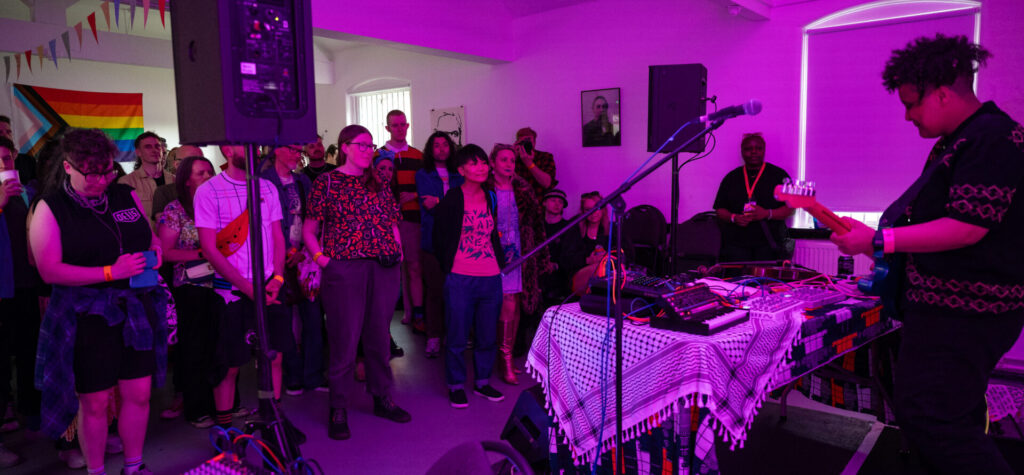
Though their primary vehicles over the last decade or so have been post punk projects like Trash Kit, Shopping and Sacred Paws, Aggs grew up immersed in folk music from a young age. “It’s been a part of my life since I was a tiny, tiny child. The experience of going to folk sessions with my parents was always super weird,” they say. “It was great on one hand,” they’re keen to stress, “because the folk community is really open and welcoming, I wouldn’t necessarily use the word ‘excluded’, but it was more of a subtle feeling, not feeling like these are my people because would I never meet anyone that looked like me. There were some weird questions I would attract that nobody else would get asked, people wanting to know where I’m from, or ‘How did you get into this music?’ I’ve been playing folk music since I remember, but that’s jarring to their ideas of who plays folk music, and their idea of what type of musical culture a Black person should know and understand.”
In 2020, “when institutions were having kind of a meltdown around diversity,” as Aggs puts it, they were contacted by Cecil Sharp House – home to The English Folk Dance And Song Society (EFDSS). “They heard about me through my mum because she’s a visible Black person in the folk scene. I think they were scrambling to find Black and brown voices within the folk community, which says a lot.” Aggs’ talk concerned the way the folk scene could work to make itself more accessible to people of colour, “which started me thinking about, I guess, why I don’t feel super welcome in some folk spaces in the UK.”
After the talk, they launched a POC-only folk session in their hometown of Glasgow, and last month also undertook Sounds From The Other City’s Samarbeta Music Residency in Salford*, delivering a talk on the topic of Decolonising Folk Music, and leading workshops and generative songwriting sessions with people of colour. “My favourite bit was actually just the chat, we ended up going to the pub afterwards. Whenever you have a POC-only space, people do get quite like, ‘Ah, yeah, now we can really talk,’ and it’s really cathartic.
“It’s been really interesting to think about my own heritage through music,” continues Aggs, whose family are African American on their mother’s side, traceable to people enslaved (and raped and impregnated) by Scottish slave owners, and English on their father’s. “Unravelling the history of movement, reclaiming the banjo as an instrument and tracing its roots back to Africa.” The old time music that Aggs plays on the fiddle, they note, “came out of the plantations, people’s shared memory of various African instruments, but then also with some Celtic influences from the slave owners, coming together to create a really weird hybrid music. It’s really interesting because that’s literally my heritage. I’m descended from slaves, but also slave owners who were Scottish, and now I’m around a lot of Scottish folk music, which I also really love.”
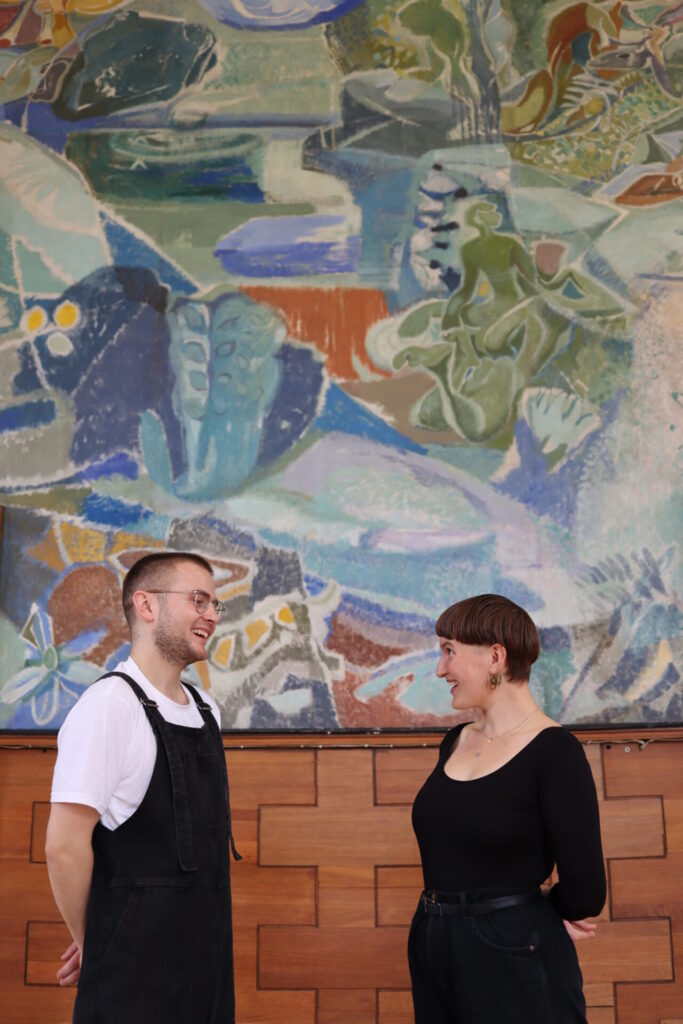
Like Aggs, the London-based musician Sophie Crawford was raised on folk music and attended regular festivals with her family as a child, but began to feel alienated as she grew up, albeit for reasons of sexuality, rather than race. “I realise in retrospect that it was because I’m gay, and I was trying quite hard to fit into something that I didn’t seem to. You can’t underestimate how much impact the 50s to 70s revival’s imagery had – working men, and women with beautiful long hair and flowery dresses, and how a lot of the music I was obsessed with seemed to also be talking about these roles – working men, and put-upon, flowing women.”
It was when she discovered later that the folk singer and sociologist Roy Bailey, a patron of the Towersey Festival she had attended regularly, was gay, that she began to reconsider. “It would have made a massive difference to me growing up if I’d known,” she says. Galvanised, she began to research queer themes that appeared in folksong, later teaming up with the musician George Sansome with whom she began an ongoing project called Queer Folk and applying for archival research residencies. “Within just a week combing the Vaughan Williams Memorial Library, she says, “we found so much more than any of us would ever be able to handle.”
The pair began with “stuff you might consider overtly queer, songs that express same sex desire, songs that have gender fluidity – there are so many about people performing in different genders, whether for humour, or to escape someone, or a woman dressing as a man to become a soldier. Then you get into a whole world of songs sung with no gender pronoun – they could be expressing desire about anyone. Or there’s a more common thing, where there’s a man singing a song that’s supposed to be from a ‘woman’s perspective’, or vice versa.
“Often it was a case of just naming what was already there,” Crawford continues. She cites Molly Dancing as an obvious example, a form of Morris from East Anglia where one of the male dancers dresses as a woman. “The main takeaway is that queer history is irrepressible.” One of the key folk collectors Cecil Sharp (he for whom the EFDSS’s house was named, and who conducted one interview about Molly Dancing in 1911 but didn’t consider it worthy of further research) “was changing lyrics all the time, trying to find a culture that was beyond, in his eyes, the ‘degeneracy’ of music hall, but even he couldn’t cut out the nuances of people’s lives.’”
This increased emphasis on diversity in the folk scene has not been without pushback. When last year a Rolling Stone UK article celebrating a supposedly ‘new’ UK folk scene that’s “less pale male and stale” triggered by Wet Leg inviting dancers from all-female troupe Boss Morris onstage at the BRIT Awards, it stirred a surge of angry and even overtly fascistic commentary when the website Tradfolk.co shared the article on Instagram. When I interviewed Goblin Band earlier this year, the group’s Rowan Gatherer recalled a YouTube commenter who claimed that their ancestors “would have killed them” for singing traditional songs as queer people. To reiterate, such arguments completely miss the point: although it’s clear that traditional music and culture can be easily hijacked by the far right, it has also always been a space where radical and progressive ideas can be explored. As Gatherer added, “it’s quite a fun side effect to freak people out with their own traditional culture and be like, ‘Actually, this has been here for your whole life, you just weren’t paying attention and now you’re being confronted.’”
Queer Folk now hosts a singaround and regular cèilidhs at Cecil Sharp House that incorporate drag performances. “It’s a no-brainer, because both queer club nights and cèilidhs are both so open,” Crawford says. “They’re also a real haven for some people from rural places where there’s a minimal queer scene, and folk is their socialising and their passion. To see that it’s important for all their identities to align and make sense is important.” They also host a monthly radio show and are plotting an album next year. She now wants focus to turn from now-thriving DIY spaces towards historic institutions. Their cèilidhs at Cecil Sharpe House, for instance, “mean that the EFDSS are having people in who have never crossed their threshold, who would never have thought about it because they felt totally excluded. To be blunt, these places were not made to feel welcoming, for people to feel open and to dress how they like.”
It speaks to the amount that’s still untapped that even this generational wave of energy is yet to dig that far beyond the surface. Embarking on a column about the kind of music its producing also raises several further issues. Firstly, when it comes to recommending my favourite new releases, as I’ve done below, where do I draw the lines as to what I consider ‘folk music’? How much do I bear in mind the boundaries between different traditions? The kind of surge we’re experiencing in England is very distinct from the scene in Ireland, for instance, where (to grossly oversimplify once more) traditions have strengthened in the act of anti-colonial resistance in a way that they haven’t in England.
Folk music’s history, however, is also one of exchange and movement across these boundaries. When I spoke to Lankum for tQ last year, for instance, I was struck by Ian Lynch’s response to the argument that the band’s embrace of experimental instrumentation and production was watering down their source material. “I don’t think there’s any such thing as purity when it comes to traditional song, or any music for that matter. Even the instruments you see in the Irish tradition now, they haven’t always been there […] It’s a story of constant movement and influences coming in from other countries.”
As I round up my ten favourite new folk releases, then, in that spirit I’ve decided to play fast and loose with these boundaries. While this first ten are drawn chiefly from the British and European musicians who I’ve been experiencing the most first hand, I hope in time to keep gradually expanding my own parameters, and to keep probing the nebulous definition of what, exactly, folk music can be.
Stick In The WheelRuins EPFrom Here
If there’s anyone who deserves their props amid this surge of attention directed towards radical folk, it’s Nicola Kearey and Ian Carter of Stick In The Wheel, who’ve been bringing an energy, political urgency and experimental drive to traditional music for a decade. New EP Ruins takes its name from the oldest known surviving manuscript of Old English literature, The Exeter Book, particularly a poem in which a narrator, writing 1,000 years ago, recounts the desolation of a city, likely Roman Bath, laid to ruin 1,000 years before that. The title track, stark spoken-word vocals set to cold electronic loops, speaks to the humanity contained in such an image – the common emotional responses that remain immortal, even as Empires rise and fall. (In an age where, from Gaza to Ukraine, cities are being ruined before our eyes, it’s worth noting that all proceeds from the release are going to Médecins Sans Frontières.)
Seeking to explore traditional material that goes back further than that which was cherry-picked by the ideology-driven, upper-class 19th century folk collectors, the band have also used the anonymous medieval poem ‘The World Is An Illusion’ as inspiration for the gorgeous ‘Long The Day’. Elsewhere, they set themselves a mission to transform the traditionally pastoral song ‘The Cuckoo’ into something that might belong in the city – a dubbed-out production evoking images of a bird flying over the towers and streets where once there were trees.
Three remixes make up the rest of the record. For the looping and chiming ‘Oroho Raha’ by Japanese Ainu musician OKI Kearey adds more words from the Exeter Book, this time a religious poem known as ‘Christ III’. An intense, droning rework of ‘Shexex’ by the Circassian band Jrpjej – the original coming from a healing ritual in which lurching vocal techniques are designed to mimic the sound of arrows wrenched from a body – is the polar opposite. Then, there is a seething ‘What Will Become Of England’ with Jim Ghedi, the record’s most explicitly political moment. Here, Kearey employs lyrics from ‘Song On The Times’, written following the repeal of the Corn Laws in the 1840s: ‘England same as always / this is how we’re bound’.
Elijah MinnelliPerpetual MusketFatCat Records
“Noted mixologist and aspiring travel agent” Elijah Minnelli claims to hail from a place called Breadminster, famous for the creation of the domestic laminator, translucent cuisine, and its discounted haircuts for those with smaller heads. There in the early 20th Century, we’re told in a press release, a fraternity called The Partnership Of The Perpetual Musket began worshipping a living effigy of a warrior wearing armour made of bread, symbolising the value of spending money on feeding the community rather than going to war. In 1915, ducks were set upon the figure in a symbolic protest against aerial bombing, a ceremony that’s been repeated every year since, with new vocalists joining each time for the performances of folk songs that have evolved alongside the ceremony.
On Perpetual Musket, Minnelli has ostensibly arranged four of these folk songs to be performed by reggae vocalists on the A-side, with dub tracks on the flip. The anti-war song ‘Vine And Fig Tree’, which originates in the Old Testament, is handed over to the legendary Little Roy. Contemporary dancehall star Shumba Youth transforms ‘Soul Cake’ – a song from an All Souls tradition once common in the British Isles, where poor people would go door to door, singing and praying for the dead in exchange for food – into a nimble earworm. Earl 16’s stark version of ‘Lifeboat Mona’ – Peggy Seeger’s composition commemorating the sinking of a lifeboat in 1959 and the death of its entire crew – comes with a stamp of approval from Seeger herself, who calls it, in all caps, “JUST RIGHT”. Bristol newcomer Joe Yorke’s brings a sublime falsetto to ‘The Wind And The Rain’, from Shakespeare’s Twelfth Night.
For all the surrealist self-mythology that Minnelli’s created, this is no novelty act. For a start, his beats are phenomenal – lithe, slinky and punchy in all the right places, leaving the perfect amount of space for each vocalist to stretch out exactly as much or as little as need be. Secondly, one doesn’t feel the tracks were selected at random. Tracks concerning poverty and the harshness of life, or that present a pacifist message, hold a particular power in our age of warmongering and inequality. The resonance of ‘Lifeboat Mona’ while fatalities from small boat crossings over the English Channel have already hit double figures this year, goes without saying.
LandlessLúireachGlitterbeat
Vocal quartet Landless are embedded in the same Dublin scene that’s spawned the likes of Lankum, ØXN, John Francis Flynn and Lisa O’Neill. Their new LP comes produced by John ‘Spud’ Murphy (who worked on the latest albums from three of those four) and features fiddle, viola and banjo from Lankum’s Cormac Mac Diarmada. And yet, their second album is best taken entirely on its own terms. Instrumentals (not only Mac Diarmada’s, but also shruti box and pump organ from the band’s Ruth Clinton and Méabh Meir respectively) are sparse – little strokes, plucks and drones deployed to gently push the song’s emotion, rather than as ornamentation. Likewise, Murphy’s production draws out emotional depths with a scalpel rather than a sledgehammer. The focus here is on the band’s extraordinary voices. Placed front and centre in the mix, they weave in and out of each other, latticing together to create a shapeshifting whole that sweeps elegantly from low, dark drones to transcendent highs. ‘The Fisherman’s Wife’, a standout, exists somewhere in the middle, simmering with power. ‘Death And The Lady’, augmented with organ, is both gentle and overwhelming. Ostensibly left-field track choices like ‘Lúireach Bhríde’, an entirely new composition concerning pre-Christian stories about the goddess Brigid, and the dazzling Slovak song ‘Ej Husari’, are melded seamlessly into the mix.
Nick Granata, Dawn TerryBetwixt & Between 10Betwixt & Between Tapes
A member of Shovel Dance Collective, and purveyor of sterling solo banjo experiments such as the aforementioned At Fargrounds LP, Jacken Elswyth also runs a sporadic tape series called Betwixt & Between, exploring, in her words, “sympathetic resonances and complimentary contrasts across traditional, improvised, and drone / ambient musics.” Each entry features a ‘mascot’ for its artwork in the form of a lino-cut mythological beast, and for the tenth edition it’s a cefusa – a dog with human hands and feet. The music comes courtesy of Elswyth’s Shovel Dance bandmate Nick Granata on one side, who performs three industrial (in the old sense) songs: a fractious ‘My Chainmaker Lad’ to tumbling minimalist backing, a gorgeous droning ‘Nailer’s Song’, and a tender a capella ‘The Lord’s Nailmaker’. Dawn Terry provides the flipside with a colossal, hypnotic hurdy-gurdy drone piece called ‘I Still Love You And I Always Will’.
The Lazy JesusUA TRIBAL vol. 2Shouka
The Lazy Jesus is the pseudonym of Ukrainian producer Ehor Havrylenko, who in a past life was a member of a number of indie and jazz projects, but now forms part of the experimental collective GRV GRV and is a resident DJ at Kyiv club HVLV. On his UA Tribal project, he employs two traditional Ukrainian instruments, the trembita, a large alpine horn, and the sopilka, a smaller flute, using them to lay down folk melodies that snake their way irresistibly around stampeding beats. On opener ‘Smok’, sparks fly as a rugged trembita line meets fractured vocal samples and punishing drums. On ‘Hlyna’ the sopilka is made evisceratingly manic. On ‘Vivchar’ and ‘Evfoniia’, things spiral out completely into hypnotic glitched-out weirdness. Also included are two remixes by South American producers, Peru’s Dengue Dengue Dengue who, like The Lazy Jesus, perform masked, and Argentina’s JaiJu, who adds an extra layer of cumbia to the mix. UA Tribal takes as much from the club as it does folk music but also finds common ground in those two spaces, where music can evoke trance-like reverie.
Ian LynchAll You Need Is Death (Original Soundtrack)Invada
All You Need Is Death, by Irish director Paul Duane, is a cosmic horror film concerning two historians who unleash evil through their recording of a mysterious woman’s never-before-heard folk songs. I’m yet to see the film, but on that synopsis it’s hard to imagine a better person for the soundtrack that Lankum’s Ian Lynch, who, when faced with the daunting project of recording new music that sounds as if it’s been around for centuries, succeeds in his mission. This project has more in touch with his One Leg One Eye solo project than his main band, where his penchant for darkness is pushed to its extremes, and moves in primal, chthonic lurches and sprawling drones. While recording, Lynch envisioned a scenario in which people living in pre-Christian Ireland might have encountered his instruments, and what noises they might have drawn from them to accompany rituals and chants. He then processed his recordings using microcassettes, four track tape loops and a reel-to-reel machine, in such a way that his compositions possess an eerie feeling of temporal and spatial suspension.
Seamas HylandMaidin DomhnaighSelf-Released
“In this recording, I wanted to stay true to the deep tradition of Irish music, but also to record music that doesn’t fall under the title of traditional music,” writes Seamas Hyland in the description of his debut album. On opener ‘Navan Road’, he achieves this without a fault. His accordion playing here is mercurial, a medley of ‘Patsy Touhey’s Reel’, an old tune named after the uilleann piper who emigrated to the US and made some of the first commercial recordings of irish traditional music, and ‘Eochaill’, and backed by skittering avant-garde drums and modular synthesiser, with field recordings of Dublin traffic woven elegantly into the mix. Elsewhere, Hyland’s self-penned ‘Press And Draw’ is spread out by synthesisers into a wistful psychedelic sweep. On the surface at least, the rest of the record is a more straightforward affair, but his playing maintains a constant, propulsive momentum that keeps it feeling urgent throughout.
Referenced artists

Goblin Band
Radical Traditional: Folk Music for Autumn, by Patrick Clarke

Lankum
LIVE REPORT: MENT Festival 2025

Jacken Elswyth
Radical Traditional: Folk Music for Winter, by Patrick Clarke
Angeline Morrison
Radical Traditional: Folk Music for Winter, by Patrick Clarke
Martin Carthy
Radical Traditional: Folk Music for Spring, by Patrick Clarke
Alula DownThe LeylineSelf-Released
Amid the scorching European drought of summer 2022, Alula Down – the project of Mark Waters and Kate Gathercole – spent five weeks travelling a section of the Apollo-Saint Michael Ley, a straight line that neatly connects a number of sacred sites associated with both the Archangel Michael and the Greek God Apollo. Journeying from the Aegean Sea to Paris, they paused at six of these sites to write sombre, meditative compositions in response to their surroundings. It’s worth noting, of course, that ley lines are almost certainly coincidental occurrences to which various parties have attributed apocryphal significance, but this album isn’t merely a flight of esoteric fancy; what shines through the most here is the band’s deep connection to the land under their feet, and to the migratory nature of their project. Field recordings – the lap of waves, the chimes of bells, the scratchy chirp of insects, the crash of summer thunder, the bustle of crowds on beaches and in cities – are deftly woven amid lyrical sketches and earthly instrumentals that dance uneasily like the haze above tarmac in the sun.
Odd AltarOdd AltarSelf-Released
It feels fitting that I unearthed this mysterious little record, not much longer than a half hour, during a late night Bandcamp trawl. Whoever the mysterious person/s behind Odd Altar are, they offer nothing in the way of biography other than a ‘UK’ tag on their location. “Instrumental folk horror of the dark ambient and drone variety” is all that features in the way of description of this self-titled album, alongside a long list of instruments used (including harmonium, harp, nyckelharpa, ukulele, guitar, fiddle, organ, synths and percussion). Subtly distorted opener ‘Woodland Cabin Tape’ begins the record on a sinister footing that intensifies as the record goes on, often flirting with dungeon synth but tempers its fantastical side with the use of field recordings and organic instrumentals played at low, earthen drones.
Broadside HacksGwenifer Raymond Live At MOTH Club / A Tribute To Les Cousins / Songs From The Wicker ManBroadside Hacks
To end this inaugural column, a brief shout out to Broadside Hacks’ folk club, held regularly at the MOTH Club in Hackney, that has emerged as one of the hubs of the new London scene. Last month saw the announcement of three limited cassettes, each of which documents a different live performance. Taken as a trio, they speak to the diversity of the Hacks’ programming and their encompassing of past, present and future. Live at MOTH Club is both a showcase for the rising guitarist Gwenifer Raymond’s forward-thinking take on American primitive guitar playing, and also a direct homage to the style’s developer John Fahey. A deeply enjoyable collection of songs from The Wicker Man featuring the likes of Katy J Pearson, Wet Leg’s Rhian Teasdale, Daisy Rickman and Goblin Band’s Rowan Gatherer, speaks to the scene’s communal joy and theatricality. A Tribute To Les Cousins is the pick of the bunch. Featuring both veterans like Wizz Jones, Bridget St. John and Martin Carthy, and those at the centre of the current scene like Angeline Morrison and Jon Wilks, it draws direct lines from the MOTH to the legendary Soho club that was central to the 1960s folk revival.
*The Samarbeta Residency currently has an open call out for their new commission, for which an artist will be asked to respond to the Hybrid Futures exhibition at Salford Museum and Art Gallery, creating a new live presentation to be premiered on the opening night of Fat Out Fest. Click here for more information.