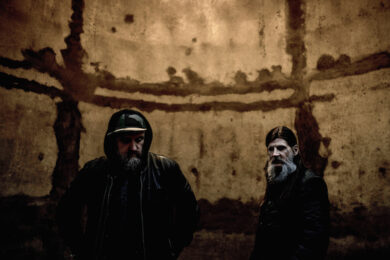

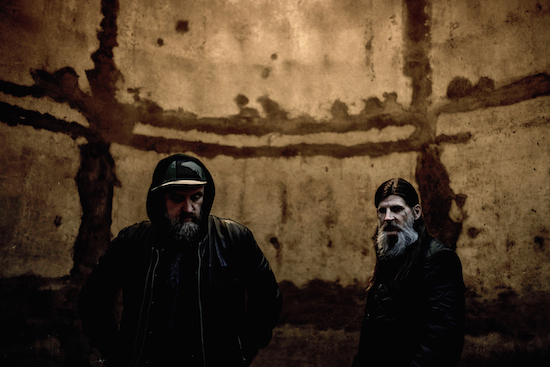
Portraits by Phil Sharp
Kevin Martin and Dylan Carlson had only met once in person when it came to recording their upcoming collaborative album Concrete Desert together under their respective pseudonyms The Bug and Earth, yet the two are quite particularly kindred spirits.
Throughout their careers as outliers in their own field, Carlson with the colossal, glacial expanses of his leviathan guitar work and Martin in the fields of dub and more, and their coming together as an intense melding of two worlds, the pair’s shared impetus on sonic landscapes and the influence of environment turned in tandem towards Los Angeles.
When working together the pair found even more in common than mutual respect for each other’s music, with shared loves of Spacemen 3, hard-boiled noir and more, a kinship that continues to unravel still as they evolve their music further on the road.
The record is in Martin’s mind a companion piece of sorts to his 2008 album London Zoo (tQ’s number one favourite album of that year), in that it somehow captures the vast, intimidating expanse of the city, distilling its unique atmospherics into sonic form. Below the pair speak to tQ about the past, present and future of a vital artistic relationship.
Can you remember the first time you heard each other’s music, and what you thought at the time?
Kevin Martin, The Bug: I heardEarth 2 when I was working as a music journalist for The Wire. It was such a dirge, at first I couldn’t even make out the riffs. It was this total, immersive, distorted sprawl. It came as a total shock but in the right way, just not knowing what the fuck it was. I’d been into stuff like Swans and slow dirge-y music but they all had a focus, while Earth 2 was like swamp distortion.
Dylan Carlson, Earth: I wasn’t aware it was him at the time, but I guess the first thing I heard would’ve been King Midas Sound, when they opened for OHM. I didn’t actually watch them because of the strobe lights and my epilepsy, but I listened to them. I can only imagine with the light show, but it was devastatingly loud. And then [the artist] Simon Fowler played London Zoo, which is also how we ended up hooking up, through Simon.
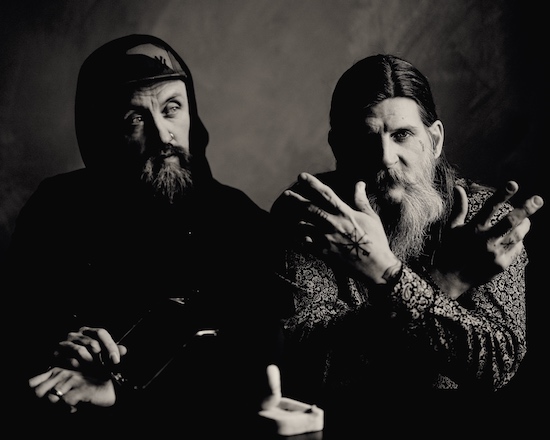
Do you see any similarities in your musical output before the collaboration?
DC: I think we both share a real commitment to the music, as opposed to any sort of trends. We both are into the way music is influenced by its environment. We also have a certain sense of sparseness where silence is of equal importance, and placement.
KM: We both approach sound in a sort of painterly fashion, as a sonic canvas. We try and somehow reflect a sprawl, and having spoken to Dylan during the album sessions his love of dub speaks volumes to me, and his love of Miles Davis, they’re right up the ladder for me in the use of spaciousness, in the deployment of sound as something that doesn’t have to be prominently in your face, it can be that much more masterful to deploy sound as a shadow than as something direct. When I listen to Earth I think his style of playing as a slow evolution, it’s not throwing technique in my face. I’m generally drawn to the colours red and blue in music, I like music that’s either total fire or total melancholy. Dylan hits those chords for me.
Equally, what did collaboration between you add to each other’s output?
KM: He inspired me to see certain tracks differently, and to see how this album could become something narratively cinematic, that could shapeshift in itself. The album was really a voyage of discovery about my relationship with Dylan, and my relationship with the city. When we were in the studio before that session I didn’t really know Dylan very well at all, we’d exchanged emails and we’d only met once, and it was interesting to get to know him musically, not just in terms of his technique and what he was playing, but what we would end up bonding about musically: Spacemen 3, which surprised me, or heavy hip-hop. For me he’s a constant source of surprise.
The album is broadly based around LA, can you tell me more about what themes you’re tackling?
KM: It was addressing my feelings towards America, my imaginative feelings of how America was once. If anything this album for me is a confrontation with my feelings whenever I’ve been in The States. I always feel alien in America, even though America is a global melting pot of everyone, a nation of immigrants, despite the present government’s protestations and futile attempts to turn it into some white trash dominance.
DC: There’s so many Americans fighting that idea tooth and nail, but the real Americans were displaced and put on reservations, for these people to stand and act like they’re the real Americans is ludicrous in the extreme.
KM: I adapted to him and the whole process kept morphing. He inspired me to see certain tracks differently, and to see how this album could become something narratively cinematic, that could shapeshift in itself. The album was really a voyage of discovery about my relationship with Dylan, and my relationship with the city.
Was the record influenced at all by modern politics?
KM: For me it’s definitely reflective of the socioeconomic makeup of the States, which is vastly divided, totally ghettoised and completely segregated. Walking through LA during the recording sessions I saw vast numbers of homeless people living on the street with no opportunities of fullfiling the American Dream, having flashy bastards driving past in flashy cars living large over the top of them, and just being disgusted by it.
DC: Consistently Americans have been willing to vote against their own economic interests for ideological reasons, and the current election is the perfect example of that. All these yahoos are pissed off and whatever, but instead of being pissed off at the people who have put them there, they’re pissed off at immigrants and minorities. Those aren’t the people that are the enemy that put you where you are, the person that put you where you are is Donald Trump!
You’ve said that in many ways it’s a companion piece to London Zoo, could you expand on that?
KM: I want to evoke the feeling of a city as I did with London Zoo. As Dylan mentioned earlier we both have vested interests in trying to portray an environment through sound. It was very specifically written as an album that would mirror in my mind how I felt about that city. From the people that have heard it the word that keeps getting used toward this album is ‘heavy’, and of course it’s dense and its heavyweight, but for me there’s a beauty. How I felt as a non-urban person moving to London in the first place, it’s how you feel as an outsider in an overwhelming city, and for me both albums share that in terms of what I’m trying to tap into.
Dylan, you lived in LA for a while, did you feel like an outsider there?
DC: I weirdly like LA in a certain way. What’s funny to me about LA is that it’s the one city that’s completely upfront about its flaws. It’s not like a lot of cities that pretend to be something they’re not, but with LA it’s like ‘love it or get the fuck out’. My view of LA is a product of James Elroy and the ugly side of the city, and I’m aware of it, so for me the city doesn’t have any pretensions.
KM: I used to be a massive reader of hard-boiled noir and American pulp crime books like Jim Thompson and James Elroy, but for me LA has that sheen. It has that Hollywood gloss and that sunshine. LA has a sheen of utopia, but it was the underbelly Dylan refers to that was more glaringly apparent to me when I was there than the sheen, which I was picking up on more.
DC: There’s a book by Mike Davis called The City Of Quartz. It’s about the ecology of the LA Basin and it’s lack of water, about the history of the city viewed from an ecological perspective, so I had that in mind as well during the album. The natural water supply there would supply a maximum of 13,000 people and there’s 13 million people in the LA Basin, so it’s like, if that was interrupted all hell would break loose.
Your time spent working together face to face has been fairly limited, how does it feel to be touring together?
DC: It’s cool because we get to mutate it even more when we play live. I think it’s benefited the live show too, the fact that we’re getting to know each other better and responding to each other. The first two shows were sort of tentative, and now we’re really getting into it.
KM: Recently we’ve both found it’s really gelling most because we have the foundation of this album, so live it’s a very different beast to the album. It’s much more overwhelming and even more intense. To play off Dylan live in a real time situation, where it’s reactive, it’s like a puzzle that keeps opening out again and again.
What’s next for you two collaboratively?
KM: I’d love to [do another album], because even just discussions with Dylan are mad interesting to me. With the live show I can hear stuff we haven’t done before that would be really interesting to explore. Also I think we have long term aspirations to work with film, but I’m aware it’s not an industry that’s open to extreme creativity. It’s only people like Mica Levi who did that incredible soundtrack [for Jackie] recently, it’s the freaks that get through the cracks that make you think ‘wow, film scoring is incredible’, when actually I think most of it is a pain in the arse. I think we still both feel the connection to sonically map a visual terrain and I’d love to work with Dylan on cinematic stuff.
Concrete Desert by The Bug Vs Earth is out tomorrow (March 24)